
Congress Plans July 21 Counter-Rally in Bengal’s Palashi to Demand Justice for Violence Victims

The Congress has announced a counter-rally in Murshidabad’s Palashi on July 21, the same day West Bengal’s ruling Trinamool Congress (TMC) is scheduled to hold its annual Martyrs’ Day rally in Kolkata, and the BJP has called for a protest march to Uttarkanya in north Bengal. Former West Bengal Pradesh Congress Committee chief and senior MP Adhir Ranjan Chowdhury made the announcement on Friday, saying the Murshidabad District Youth Congress will organize a protest meeting demanding justice for Tamanna and Abhaya — two young victims of post-election violence allegedly involving TMC workers. “We are holding a rally at the historic plains of Palashi to seek justice for little Tamanna, who died in a bomb attack in Kaliganj after the elections, and our sister Abhaya. We consider them martyrs,” Chowdhury said at a press briefing at the Congress office in Berhampore. Although the program is being held under the banner of the district youth wing, Chowdhury claimed the organizers have already applied for police permission, similar to the BJP, whose rally in north Bengal was recently cleared by the Calcutta High Court. The announcement adds a third major political event to 21 July— a date charged with political symbolism in West Bengal. While TMC commemorates the 1993 police firing in Kolkata that killed 13 Youth Congress workers, the day has also become a battleground for political messaging. Referring to the High Court’s recent directive asking Kolkata Police to ensure that the TMC rally does not disrupt normal life in the city, Chowdhury remarked, “The decision of the High Court is absolutely right. Why should ordinary people suffer for what has become a picnic and pleasure trip in the name of Martyrs’ Day?” He also criticized Chief Minister Mamata Banerjee for allegedly rewarding police officers responsible for the 1993 firing, while remaining silent on investigating the incident. “The state government is quiet on who ordered the firing and who was responsible,” he said. Chowdhury’s statements and the Congress’s Palashi event add further tension to an already politically charged day in West Bengal, as all three major parties seek to dominate the narrative.
Controversy erupts over BDO’s gala birthday celebration inside office premises
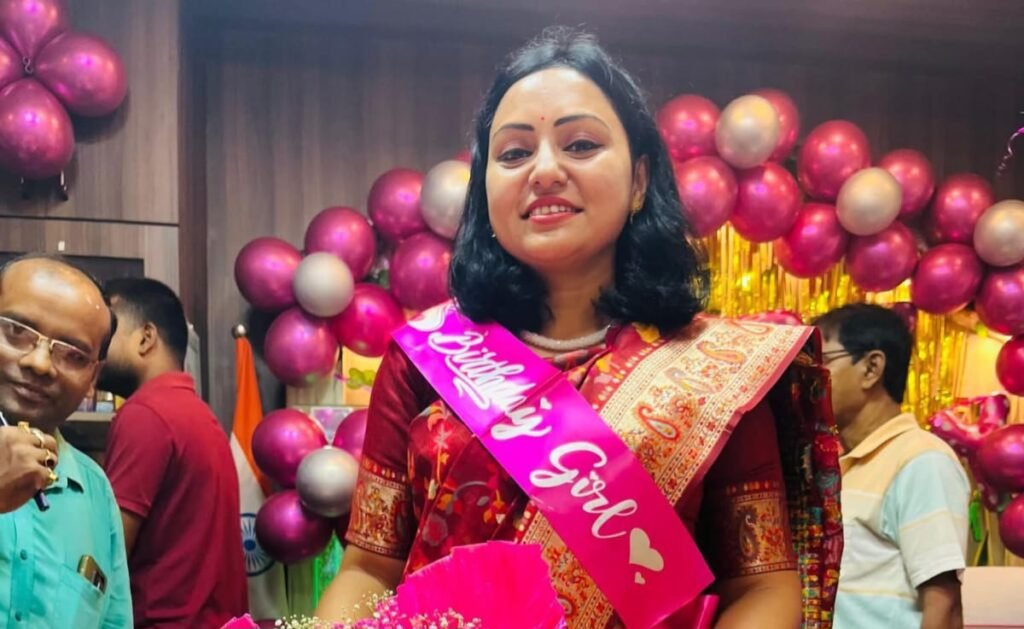
A fresh controversy has erupted in West Bengal after a video surfaced showing a senior government officer celebrating her birthday with pomp inside her official chamber during work hours. The incident took place on July 14 at the office of the Block Development Officer (BDO) in Haringhata, Nadia district, where BDO Mahasweta Biswas was seen celebrating her birthday for nearly an hour with decorations, music, cake-cutting, and party accessories — all during regular office hours. The office, adorned with balloons and darkened for effect, resembled a banquet hall more than a government facility. As the clock struck noon, Biswas entered the room to the sound of the “Happy Birthday” song, greeted by staff wearing party hats and a table laid with a large birthday cake. The celebration temporarily brought official work to a halt, while citizens waited outside the office to seek redressal for various grievances. “Rules took a backseat that day,” said a local resident standing outside the office during the event. The incident comes just days after a similar video went viral from East Burdwan, where Rajneesh Kumar Yadav, the BDO of Burdwan–I block, celebrated a pre-wedding ritual in his office on July 4, drawing criticism on social media. Kalyani Sub-Divisional Officer Dr. Abhijit Samanta told reporters, “This should not happen in a government office. Sometimes these things are done by staff without informing the officer. But if it disrupts public service and creates inconvenience to citizens, it is certainly inappropriate.” However, Biswas defended the celebration, saying, “There’s nothing unusual about it. I don’t see anything wrong. It was a simple gesture by my staff, and perhaps the decorations went a bit overboard because of the affection they have for me.” The incidents have sparked debate over the appropriateness of holding personal celebrations in government offices, raising questions about official decorum and accountability in public service.
Dilip Ghosh Skips Modi Rally in Durgapur Amid Rift with BJP Bengal Unit
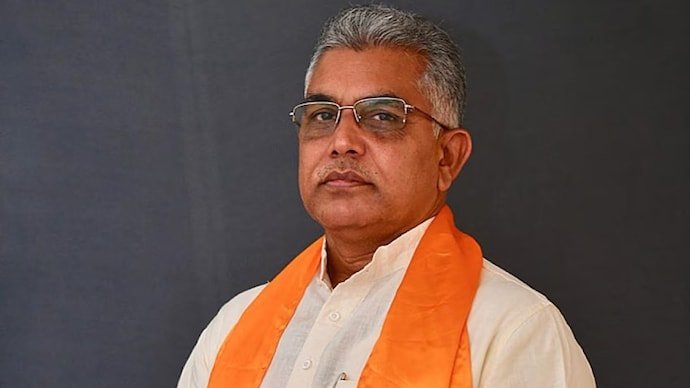
Senior Bharatiya Janata Party (BJP) leader Dilip Ghosh will not attend Prime Minister Narendra Modi’s rally in Durgapur on Friday, signalling deepening tensions between the former West Bengal party chief and the state leadership. Ghosh, currently a national vice president of the BJP, confirmed on Friday morning that he was flying to New Delhi instead. Speaking to reporters at Kolkata airport, Ghosh said, “Workers had invited me, but it seems the party does not want me at the rally. If my presence creates discomfort, I will stay away.” His absence from the Prime Minister’s event comes amid ongoing speculation over his marginalisation within the party’s Bengal unit. While local workers had reached out to him regarding Modi’s public meeting, Ghosh maintained that he never received a formal invitation from either the state or central leadership. “I had planned to attend as a party worker. But I was not officially invited,” he said. For days, uncertainty surrounded whether Ghosh would be present on the dais alongside the Prime Minister. Conflicting reports circulated, with some sources claiming he was sent an invitation, while others, including Ghosh himself, denied it. On Thursday night, he posted a cryptic message on social media: “We will remain. You are welcome,” adding fuel to speculation. Ghosh, known for his grassroots appeal and vocal criticism of internal party decisions, has been increasingly sidelined in recent months. He was not invited to key events such as the recent visits of BJP national president J.P. Nadda or Union Home Minister Amit Shah, nor did he play any role in the state leadership transition that saw Shamik Bhattacharya take over as BJP’s West Bengal president. Although Ghosh visited the BJP’s Salt Lake office recently — his first appearance there in months — hopes of a reconciliation appear to have dimmed again. “I’m going to Delhi on party work,” Ghosh said on Friday, declining to elaborate further. His absence from Modi’s rally, one of the biggest political events in the state ahead of upcoming assembly by-elections, is being widely viewed as a sign of a widening rift between Ghosh and the Bengal BJP leadership. The BJP has yet to comment officially on Ghosh’s remarks or his absence from the event.
Calcutta High Court Flags Traffic Disruption Ahead of Trinamool’s 21 July Rally
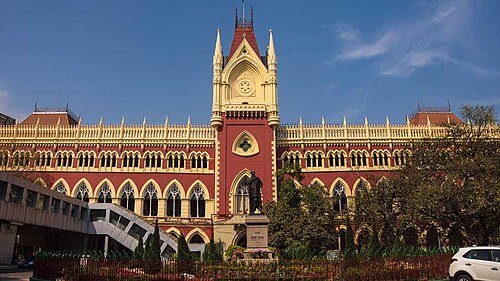
The Calcutta High Court on Thursday issued strong observations over possible disruption to public life due to the Trinamool Congress’s annual 21st July rally, prompting concerns over traffic management in the city. The remarks came during a hearing on a petition filed by a Left-affiliated lawyers’ body, which expressed apprehension that the large-scale political event could paralyse central Kolkata for hours. While Justice Tirthankar Ghosh clarified that the court would not interfere with the rally this year, he questioned the burden such events place on ordinary citizens. “How long can the public tolerate this?” he asked, signalling displeasure at the scale of inconvenience anticipated. The state’s Advocate General defended the rally, saying permissions were obtained through due process. “Even during visits by the President or Prime Minister, similar traffic restrictions are imposed. This rally has been held for over three decades,” he said. The court, however, was not convinced. “Will the Kolkata Police Commissioner give an undertaking that there will be no traffic jams?” Justice Ghosh retorted, adding that authorities must be mindful of public tolerance limits. Issuing specific instructions, the court directed that: No rally-bound participants may enter the city after 11 a.m. on Sunday; Only those already present in Kolkata by then may attend the rally; At least one-third of the road space must be kept clear for vehicular movement. The petitioner, lawyer Shamim Ahmed, argued that while he was not opposing any political event, there must be parity in how permissions are granted. “Why is one party allowed such access while others face restrictions?” he asked, citing a July 16 notification that warned of 20-hour traffic closures in parts of central Kolkata. In response, the state’s counsel said traffic regulations apply uniformly to all major events, including religious festivals and rallies by other parties. The court further suggested that future political gatherings of such magnitude be held in large venues like stadiums to reduce strain on public infrastructure. “Why not use a stadium with a capacity of one lakh? The roads belong to everyone,” Justice Ghosh said. The court also instructed the West Bengal government to develop a comprehensive policy for large-scale public events to prevent future hardship to residents. Observers note that the 21st July rally, commemorating the 1993 police firing on Youth Congress workers, has over the years become a show of strength for the ruling Trinamool Congress. But with growing urban congestion, questions over the location and scale of such events are gaining prominence. The state government is yet to respond to the High Court’s suggestions.


