
TMC to ‘Bowl Out’ Rivals from Martyrs’ Day Stage

West Bengal Chief Minister Mamata Banerjee on Sunday rallied party workers with a combative call to “bowl out” political opponents in the 2026 Assembly elections, invoking cricketing metaphors and Bengali pride from the annual July 21 Martyrs’ Day rally, a major event on the Trinamool Congress calendar. “Hit them for a six. This time, we must bowl them out,” Banerjee declared from the stage at Dharmatala, energizing the gathering of thousands of party workers and supporters who had converged since early morning. Positioning herself as the captain leading from the front, Banerjee said, “I will take on ten people alone if I have to. I will not rest until we unseat the BJP from Delhi.” The TMC supremo’s address fused electoral strategy with emotional appeals, touching upon issues such as NRC, voter list revision, Bengali linguistic rights, and central deprivation. She set clear targets for the 2026 polls, signaling that the party would intensify its campaign to secure a larger majority. In a symbolic gesture, Banerjee handed over ₹2 lakh each to the families of two Bengal residents killed in the Poonch terror attack—Jhantu Ali Sheikh and Bitan Adhikari—demonstrating solidarity with martyred jawans. Taking aim at Prime Minister Narendra Modi, Banerjee criticized him for invoking “Jai Ma Durga” and “Jai Ma Kali” during his recent speech in Durgapur, calling it a superficial attempt to appeal to Bengali voters. “Reading two lines in Bengali from a teleprompter doesn’t make you Bengali. They have no understanding, no connection with our culture,” she said. Banerjee also condemned the Centre over the Citizenship Amendment Act and its implementation. “If this disastrous law is not withdrawn, we will gherao the Election Commission. We will not allow anyone to trample on Bengal or Bengalis,” she warned. On the issue of alleged harassment of Bengali speakers in BJP-ruled states, the Chief Minister targeted Assam’s Chief Minister Himanta Biswa Sarma. “He can’t even manage Assam properly, and he’s meddling in Bengal. If needed, we’ll all go and see how many people he dares to put in detention camps,” Banerjee said, directing her party MP Sushmita Dev to lead resistance efforts. Banerjee also reflected on her own political journey and past struggles, recalling a near-fatal assault during a protest at Hazra. “My head was shattered. I survived only because I walk and exercise. I’ve been fighting ever since,” she said. With her fiery address, Mamata Banerjee made it clear that the road to 2026 has already begun—and the TMC, under her leadership, intends to play an aggressive innings.
Mamata Banerjee Calls for New Language Movement to Protect Bengali Identity
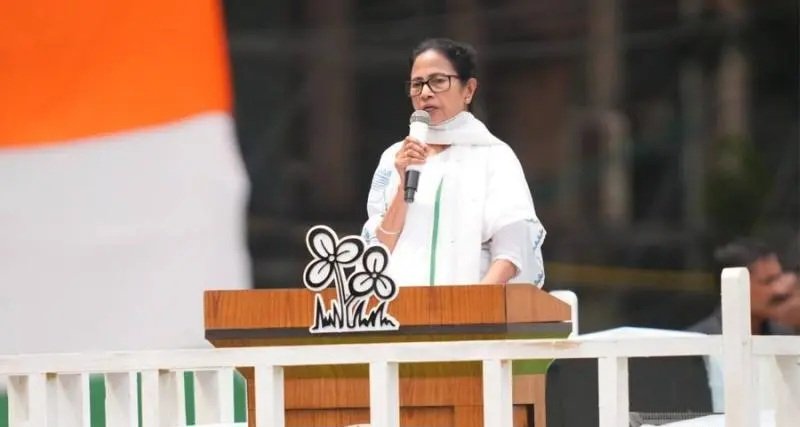
West Bengal Chief Minister Mamata Banerjee on Sunday issued a sharp call to defend the Bengali language and identity, warning against what she described as “linguistic terror” in several BJP-ruled states. Speaking from the Martyrs’ Day rally stage in Kolkata, Banerjee hinted at launching a renewed language movement to safeguard Bengali speakers facing discrimination outside the state. “There’s a concerted attack on the Bengali language. People are being branded as Bangladeshis just for speaking Bengali in other parts of India,” Banerjee said. “Who has the right to decide what language someone speaks or what food someone eats? Everyone’s rights will be protected in Bengal.” Banerjee, who is also the chief of the Trinamool Congress, accused the BJP of targeting linguistic and cultural diversity and urged her party members to resist these trends through organised public action. Outlining a plan of resistance, she instructed her party’s MPs to lead peaceful demonstrations alongside civil society representatives at the Bhasha Shahid Udyan (Language Martyrs’ Memorial). She also proposed weekend rallies and meetings involving speakers of all languages to show solidarity. “When language becomes a tool of politics, we must not retreat even an inch,” Banerjee said, declaring her intent to preserve linguistic rights. “In Bengal, every language will be respected, but we will not allow anyone to trample on our mother tongue.” The Chief Minister’s speech came amid growing concern over Bengali-speaking individuals allegedly facing harassment in parts of northeastern India. Echoing the tone of an agitation reminiscent of the historic language movements in the subcontinent, Banerjee concluded with a promise: “We will continue to fight for the honour of Bengali and the rights of all languages.”
Abhishek Banerjee dares BJP to chant ‘joy Bangla’, launches 2026 poll challenge from martyrs’ day stage

Abhishek Banerjee, the national general secretary of the Trinamul Congress (TMC), launched a fierce attack on the Bharatiya Janata Party (BJP) from the July 21 Martyrs’ Day rally in Kolkata, throwing down the gauntlet for the 2026 West Bengal Assembly elections. Paying homage to the 13 youth Congress workers killed in the police firing on this day in 1993, Banerjee knelt in reverence at the memorial before addressing a packed gathering in central Kolkata. The Diamond Harbour MP positioned the BJP—not the CPI(M) or the Congress—as TMC’s principal political adversary in the state. “In BJP-ruled states, Bengalis are being persecuted. Earlier they chanted ‘Jai Shri Ram’. Now, under pressure, they are saying ‘Jai Ma Kali’ and ‘Jai Ma Durga’. After 2026, we’ll make them say ‘Joy Bangla’,” said Banerjee, without naming Prime Minister Narendra Modi. His remark came in the wake of Modi invoking Hindu goddesses at a recent rally in Durgapur. Setting the tone for the 2026 elections, Banerjee declared, “In Bengal, BJP is our only enemy. We will send them to a democratic detention camp.” He accused the BJP of attempting to suppress West Bengal’s identity and culture through coercive tactics, including federal investigative agencies and electoral manipulation. “The BJP calls Bengali speakers Bangladeshis. It has been 15 days since the Assam Chief Minister made such a comment. What action has the Centre taken?” Banerjee asked, adding that Trinamool MPs would not hesitate to speak in Bengali in Parliament to assert linguistic pride. Banerjee alleged that the BJP, unable to win popular support in Bengal, was using the Election Commission, the CBI, and the ED to subvert the electoral process and target opposition leaders. “They have failed to write their name on Bengal’s soil, so now they conspire from behind the scenes,” he said. He closed with a call for BJP’s ouster from the state in the next polls. “I don’t make predictions lightly. But when I do, I mean it. The trash that remains must be swept into the Bay of Bengal. In 2021, I said ‘Khela Hobe’—this time, I say uproot the lotus,” he thundered. In a pointed challenge to the Centre, he concluded, “We will not sell our spine. Do your worst—we won’t be silenced.”
Joint Army Training to Boost Battle Readiness
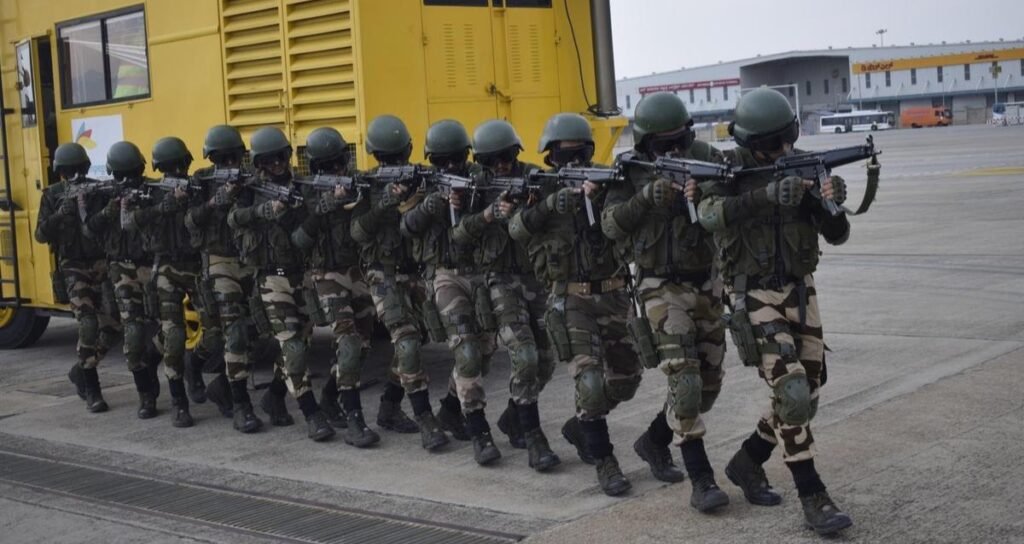
India’s Central Industrial Security Force (CISF) has begun intensive joint training with the Indian Army in a bid to enhance its preparedness against emerging hybrid and unconventional security threats, officials said on Monday. The move is part of a broader strategy to make the paramilitary force “battle ready” for defending critical infrastructure such as airports, nuclear plants, government buildings, and Parliament in the event of high-impact threats such as coordinated terrorist attacks, drone intrusions, or sabotage operations. For the first time, full batches of CISF personnel are undergoing training at Indian Army installations in the Kashmir Valley. Previously, access to such training was limited to a small number of personnel. The current modules include night operations, jungle warfare, close-quarter combat, and endurance-building exercises. “These joint drills will significantly enhance the operational effectiveness of our Quick Reaction Teams deployed at high-value installations,” a senior CISF officer told Reuters on condition of anonymity. “The emphasis is on speed, precision, and composure under high-pressure scenarios.” The trainees are drawn from CISF’s elite Quick Reaction Teams (QRTs), the first responders to any emergency across the force’s 369 units. Only personnel under the age of 35 who have passed the Battle Physical Efficiency Test (BPET), benchmarked to National Security Guard (NSG) standards, are being selected. All participants have already completed six months of in-house tactical training prior to joining the Army module. The Indian Army’s involvement marks a deeper civil-military collaboration aimed at bolstering internal security preparedness at a time of heightened concerns over non-traditional threats. CISF officials said the force plans to gradually extend the Army-led advanced training programme to more units, focusing first on those stationed at high-risk locations. “Our goal is to raise the entire force’s physical resilience, tactical skills, and psychological preparedness to deal with evolving threats,” the official added. CISF, which operates under the Ministry of Home Affairs, plays a critical role in securing India’s key government and industrial assets, including over 60 airports, space centres, and strategic installations.


