
India’s PM Modi Meets President Murmu Amid Parliament Logjam and US Trade Tensions
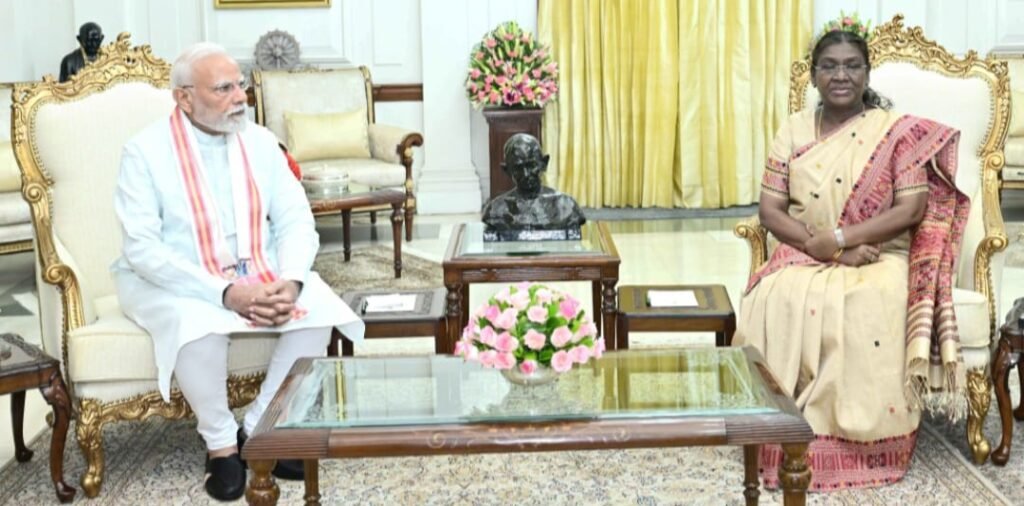
Prime Minister Narendra Modi met President Droupadi Murmu at the Rashtrapati Bhavan on Sunday amid an ongoing deadlock in Parliament and rising diplomatic friction with the United States over trade and defence ties with Russia. The Rashtrapati Bhavan confirmed the meeting in a brief statement posted on social media platform X (formerly Twitter), saying: “Prime Minister Shri @narendramodi called on President Droupadi Murmu at Rashtrapati Bhavan.” However, no further details of the meeting were made public. The meeting came as Parliament remained largely stalled since the start of the Monsoon session on July 21, with opposition parties demanding an in-depth discussion on the Special Intensive Revision (SIR) of electoral rolls in Bihar. The opposition has alleged irregularities in the SIR process, calling it a politically motivated move ahead of the state assembly elections due next year. Except for brief discussions in both Houses on “Operation Sindoor,” a military-led rescue and repatriation mission, legislative business has been minimal as both Houses witnessed frequent disruptions and adjournments. Modi’s visit to the President also follows growing diplomatic tensions between New Delhi and Washington. Just days earlier, former U.S. President Donald Trump announced a 25% tariff on Indian exports and signaled possible further penalties in response to India’s continued purchases of Russian oil and military hardware—moves that have drawn criticism from the U.S. and other Western nations amid the ongoing Ukraine conflict. While the Indian government has not officially responded to Trump’s announcement, New Delhi has consistently defended its strategic autonomy and maintained that its energy and defence imports serve its national interests. Analysts view the Prime Minister’s meeting with the President as a customary but significant consultation during a politically sensitive period marked by legislative paralysis and foreign policy headwinds. With key bills pending and crucial state elections approaching, pressure is mounting on the ruling Bharatiya Janata Party (BJP) to restore order in Parliament and address both domestic and international concerns.
Infant’s Death Triggers Protests over Poor Drainage, Roads in North Dum Dum
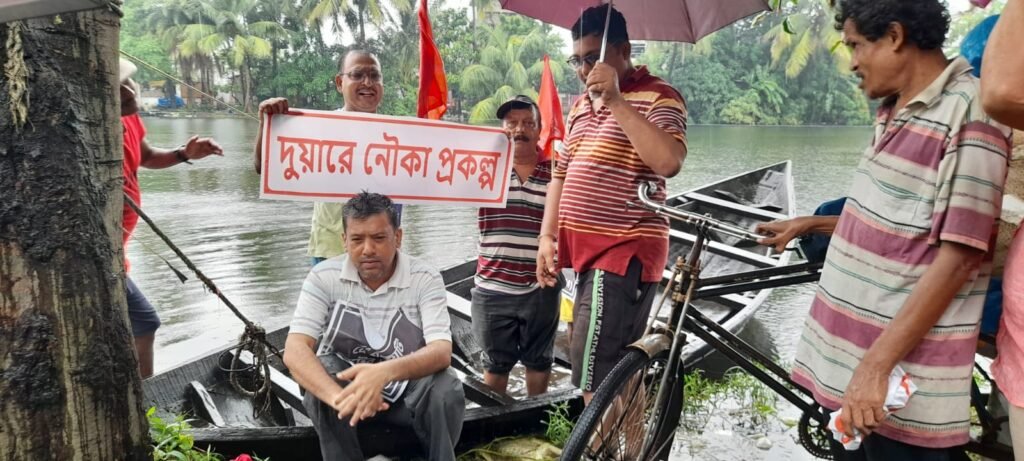
The death of a six-month-old infant who reportedly fell into stagnant water in the Debinagar area of North Dum Dum Municipality’s Ward No. 13 has triggered widespread protests, highlighting serious civic infrastructure issues in the region.The child’s grandmother recounted the horror, saying the baby fell into the water while asleep. “Had we lived in a concrete house, she might have been saved,” she said. Their house, like many in the area, is semi-permanent and vulnerable to water ingress. Inside, the floor remains submerged, littered with dead snails and fish swimming about—symptomatic of the appalling living conditions residents endure every monsoon. Just across the street, several houses built under the West Bengal government’s ‘Banglar Bari’ (Homes for Bengal) housing scheme stand in stark contrast to the victim’s fragile dwelling. Locals are now questioning why the child’s family was overlooked during beneficiary selection. “Even if they didn’t apply, couldn’t a local councillor have included their name seeing their condition?” asked a neighbour. Large parts of North Dum Dum remain waterlogged following heavy rains, with residents blaming poor drainage systems and crumbling road infrastructure for the worsening conditions. Protesters said the MB Road and several adjoining stretches are riddled with potholes, increasing the risk of accidents. On Sunday, members of the Democratic Youth Federation of India (DYFI), Students’ Federation of India (SFI), All India Democratic Women’s Association (AIDWA), and the Communist Party of India (Marxist) [CPI(M)] staged a road blockade at the mouth of the MB Road-Birati Bridge, demanding immediate improvement of drainage and road conditions. The protest, which continued for over half an hour in heavy rain, led to a standoff with officers from Nimta Police Station, who arrived at the scene to disperse the crowd. Heated arguments reportedly broke out between the police and the demonstrators. Among the key leaders present were Rounak Das, Secretary of DYFI’s Birati-Bisharpara regional committee; Susmita Dasgupta and Aitreyee Guha, senior members of AIDWA; Atashi Chakraborty, an AIDWA national leader and CPI(M) state committee member; Pintu Chakraborty, CPI(M) North 24 Parganas district committee member; and Shibshankar Ghosh, secretary of the party’s area committee. Local CPI(M) cadres, along with youth, students, and women’s wings of the party, actively participated in the protest, demanding urgent government action to prevent further tragedies.
Ancient Hindu Idols Unearthed During Excavation in Kashmir’s Anantnag District

Ancient Hindu stone idols, including several ‘Shivlings’, were unearthed during excavation work for the renovation of a spring in Jammu and Kashmir’s Anantnag district, officials said on Saturday. The artefacts were discovered at Karkoot Nag, located in the Salia area of Aishmuqam in southern Kashmir, during an ongoing revival and restoration project being carried out by the Public Works Department, officials said. Local labourers involved in the excavation recovered the idols, many of which are carved with depictions of deities, from the sacred pond at the site, which holds religious significance for Kashmiri Pandits. Officials from the Jammu and Kashmir Department of Archives, Archaeology and Museums have since visited the site and said the relics will be transferred to Srinagar for further analysis, including material and dating tests to determine their historical origin. “We will shift them to the SPS Museum in Srinagar, where they will be studied by scholars and researchers,” a department official said. The site is associated with the Karkoota dynasty, a powerful Hindu dynasty that ruled Kashmir in the 7th and 8th centuries CE. Community members believe that a temple may have once stood at the location or that the idols may have been placed there for preservation. “This place has been a pilgrimage centre,” said a local Kashmiri Pandit. “We recovered Shivlings, sculptures, and other sacred items. We appeal to the government to protect the site and rebuild the temple where these idols can be respectfully placed.” The discovery has renewed interest in the region’s ancient Hindu heritage and calls for preservation and archaeological investigation.


