
Calcutta High Court urges stakeholders to resolve Metro viaduct clearance issue

The Calcutta High Court on Wednesday suggested that all stakeholders meet to resolve the impasse over police clearance for construction of a viaduct on the Kavi Subhash–Airport Metro line at Chingrighata, across the Eastern Metropolitan Bypass. Completion of the viaduct will allow commercial services to begin between Kavi Subhash and Sector V Metro stations, easing travel for thousands of commuters. A division bench presided over by Justice Sujoy Paul, with Justice Smita Das De, said the issue should be addressed in “larger public interest.” The court directed counsels representing the Metro Railway, Rail Vikas Nigam Ltd. (RVNL), the West Bengal government and Kolkata Police to inform it on Thursday of the date of a proposed meeting and the names of officers authorized to take decisions. “During the course of hearing, the court suggested that in order to solve the problem which is in larger public interest, why not competent officers of all stakeholders sit together to find out a solution,” the bench noted in its order. The counsels welcomed the proposal and agreed to update the court on scheduling. The bench said it will fix a date and time limit for the joint meeting after receiving inputs on Thursday. Prime Minister Narendra Modi inaugurated three new Metro sections in Kolkata on Aug. 22, including part of the Kavi Subhash–Airport line. Services on the line currently operate up to Beleghata from Hemanta Mukhopadhyay (Ruby Hospital) station. Metro Railway authorities said they are awaiting police permission to launch girders at the Chingrighata crossing, which will link already completed stretches on both sides.
Hindus Outraged by Trump Adviser Navarro’s ‘Anti-Brahmin’ Remark
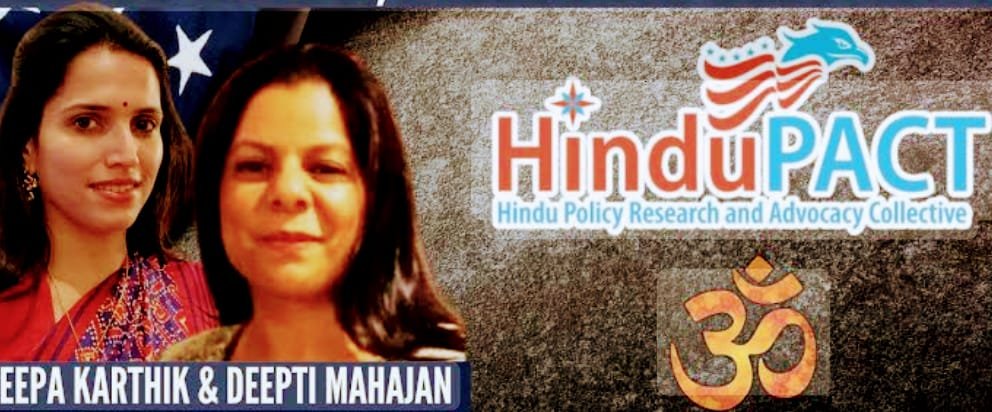
Hindu groups in the United States are demanding the removal of Donald Trump’s trade adviser Peter Navarro after he made remarks accusing India’s Brahmin community of profiteering from discounted Russian oil, sparking a storm of criticism both in the US and India. Speaking at a recent policy discussion, Navarro claimed that India was acting as a “laundry for the Kremlin,” purchasing crude oil from Russia at discounted prices, refining it, and then selling it to Europe at a profit. In his comments, he singled out “Brahmins,” suggesting they were reaping the benefits of the trade “at the expense of the Indian people.” “India is nothing more than a laundromat for the Kremlin… you’ve helped the Brahmins profit at the expense of ordinary Indians. This has to stop,” Navarro said, without clarifying why he referred specifically to the Brahmin community. The remark has been met with strong backlash from Hindu advocacy groups in the United States, who accuse Navarro of fueling caste-based divisions and displaying what they describe as “colonial arrogance.” Ajay Shah, executive director of the Washington-based advocacy group HinduPACT, called the comment “pure Hinduphobia.” “This has nothing to do with foreign policy,” Shah said. “It is a divisive remark targeting Hindus with a colonial mindset.” Deepthi Mahajan, president of the same organization, added: “If Navarro was addressing Hindus as a community, this is religious bigotry. If he was addressing India’s leadership, it is a diplomatic misstep. Either way, the statement is reckless.” The controversy has spilled over into Indian political circles as well. On X, Indian parliamentarian Sagarika Ghosh sought to contextualize the comment, noting that the phrase “Boston Brahmins” was historically used in the United States to describe wealthy elites. “Even today, some English speakers use ‘Brahmin’ as a shorthand for the rich,” Ghosh explained, suggesting Navarro’s usage may have drawn from that lineage. Still, Hindu groups argue the impact of his words is deeply damaging. “This is an attempt to sow divisions among Hindus,” Shah said. “We reject this rhetoric and call for his immediate dismissal from the Trump campaign.” Navarro, who has been a close adviser to Trump since his first administration, also criticized Indian Prime Minister Narendra Modi’s ties with Russian President Vladimir Putin and Chinese President Xi Jinping. “I don’t understand why the world’s largest democracy would choose to stand with Putin and Xi,” he said. With Trump campaigning for a return to the White House in 2025, Navarro’s remarks threaten to strain relations with Indian-American voters, many of whom see his words as inflammatory and divisive.
Landslide Kills 6 in Himachal Pradesh, Several Homes Destroyed
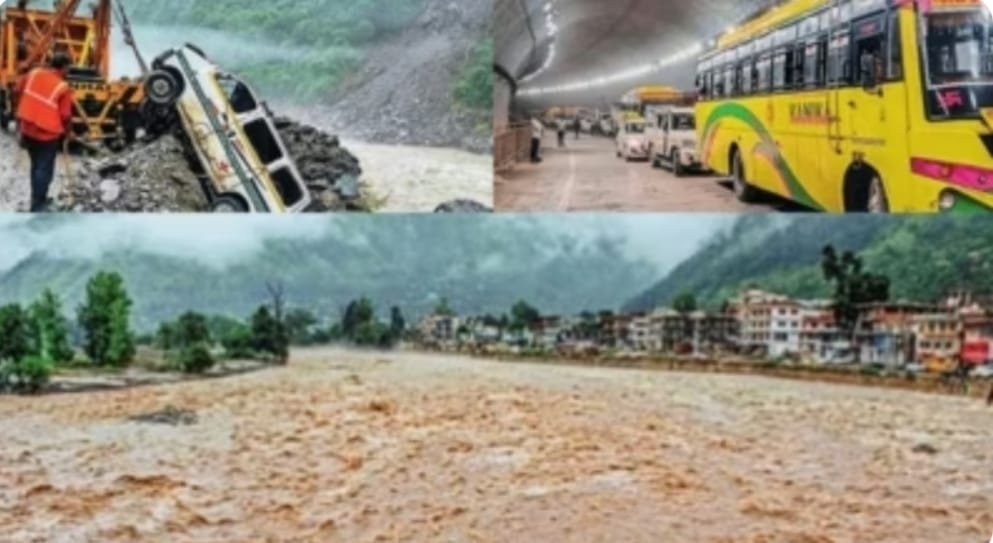
Heavy rains triggered a landslide in Himachal Pradesh’s Mandi district, killing at least six people and leaving two others missing, officials said Wednesday. The landslide struck Sundernagar area, where four members of the same family were among the dead. Authorities said 16 houses were completely destroyed in Darki hill area, while another 40 remain in a precarious condition. A red alert was issued, and the entire village was evacuated. “Most residents had already moved out sensing the danger, which helped prevent more casualties,” a local official said. The district administration announced that schools would shift to online classes until further notice. Landslides and flooding have blocked at least 1,333 roads across the region, officials added. The India Meteorological Department had earlier issued a warning of extremely heavy rainfall in parts of Kullu, Chamba, Kangra and Mandi districts until noon. Forecasts also suggest heavy rain may continue in Bilaspur, Hamirpur, Kinnaur, Lahaul-Spiti, Shimla, Sirmaur, Solan and Una. Deadly monsoon-triggered landslides are common in Himachal Pradesh, where steep terrain and fragile soil make villages vulnerable to heavy rain.
Former Bengal minister Paresh Chandra Adhikari, daughter Ankita surrender in SSC recruitment scam case

Former West Bengal minister Paresh Chandra Adhikari and his daughter Ankita Adhikari surrendered before a special CBI court in Alipore on Wednesday in connection with the multi-crore SSC recruitment scam. Both appeared in court and filed bail petitions. Alongside them, Sukanta Acharya, personal secretary to former education minister Partha Chatterjee, also surrendered. Several others accused in the case, including Partha Chatterjee, Samarjit Acharya and Parna Basu, moved for bail as well. The Central Bureau of Investigation (CBI) has opposed the bail pleas, arguing that each case carries distinct charges and that the recruitment irregularities have had a “serious impact on society.” The developments come just days after the CBI filed its final charge sheet in the SSC Group C recruitment case. Earlier, the agency had submitted charge sheets in the Class IX-X and Class XI-XII recruitment cases. In total, four charge sheets have now been filed across multiple cases, with around 75 accused summoned to court. Ankita Adhikari, who had secured a teaching post in political science for Classes XI-XII through SSC, was named in the infamous “tainted candidates list” at No. 104. Her appointment was challenged in court by job aspirant Babita Sarkar, leading Justice Abhijit Gangopadhyay of the Calcutta High Court to cancel her appointment in May 2022 and order her to return nearly Rs 15 lakh in salary. The money was later awarded to Sarkar, though her own appointment was also cancelled due to evaluation errors. Eventually, another candidate, Anamika Roy, was appointed, only to lose her job too when 26,000 appointments were annulled last year. The SSC scam probe began in 2022, and within 51 days the CBI filed its first charge sheet naming senior officials and political figures, including Partha Chatterjee, Samarjit Acharya, ex-adviser Shanti Prasad Sinha and former SSC chairman Soumitra Sarkar. While the final charge sheet includes no new names, sources say it contains fresh evidence, including voice samples collected from five accused. The case, involving illegal appointments in Groups C and D as well as Classes IX-XII, remains one of the largest recruitment scandals in Bengal’s history, with investigations still ongoing.
Kolkata emerges as fertility hub as IVF demand grows across borders
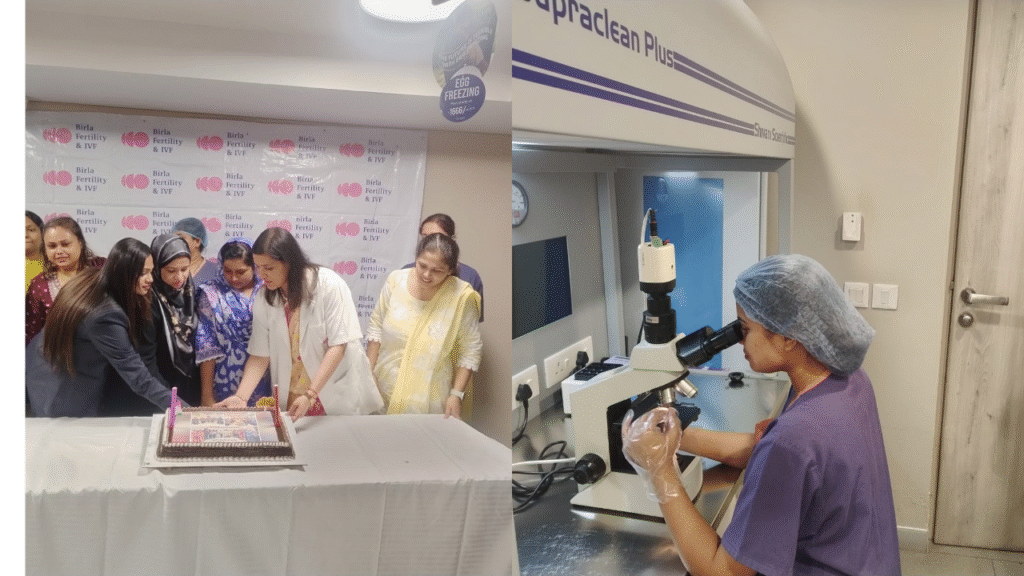
Kolkata is fast emerging as a leading destination for fertility treatments in South Asia, attracting patients not only from across India but also from neighbouring countries and even Western nations. According to Dr Swati Mishra, Centre Head and Senior Consultant at Birla Fertility & IVF Kolkata, patients from Bangladesh, Nepal, Bhutan, the United States and the United Kingdom are regularly travelling to the city to seek advanced reproductive care. Dr Mishra said lifestyle-related conditions now play a significant role in fertility challenges. “Issues such as polycystic ovary syndrome (PCOS), endometriosis, premature ovarian failure, azoospermia and reduced sperm health account for nearly a third of cases we see. These reflect broader urban health patterns linked to stress, irregular sleep, sedentary lifestyles and poor dietary habits,” she explained. She also pointed to a noticeable rise in younger women opting for egg freezing, a sign of growing awareness around fertility preservation. “This reflects the confidence women now have in planning their reproductive choices at the right time,” Dr Mishra added. Birla Fertility & IVF, part of the CK Birla Group, has marked four years of operations in Kolkata, having grown from its first centre in 2021 to three facilities across the city, including a recently launched clinic in New Town. “This expansion demonstrates both the rising demand for advanced fertility solutions and the trust patients place in us,” Dr Mishra said. The company’s CEO, Abhishek Aggarwal, said the Kolkata centres serve not just the city but the wider eastern region and beyond. “Completing four years in Kolkata is a reflection of the trust this city has placed in us. Our centres here cater to patients from Kolkata, Eastern India and Bangladesh. As we expand towards building 100 clinics nationwide, our priority will remain affordable, accessible and clinically reliable fertility care,” Aggarwal said. Specialists highlight that Kolkata offers a full spectrum of fertility treatments. Birla Fertility & IVF provides in-vitro fertilisation (IVF), intracytoplasmic sperm injection (ICSI), intrauterine insemination (IUI), frozen embryo transfer (FET), blastocyst culture, as well as male and female infertility treatments. The centres also cater to advanced needs such as cancer fertility preservation, preimplantation genetic screening (PGS) and preimplantation genetic diagnosis (PGD). For many patients, Kolkata offers an affordable alternative to treatment in other parts of Asia or the West, without compromising on technology or expertise. Doctors say the city’s growing reputation as a hub for fertility solutions reflects both changing social realities and medical progress in Eastern India.


