
Kolkata marks Sukanta Bhattacharya’s centenary with poems on city walls

Kolkata, long celebrated as the city of poets and revolutionaries, paid tribute on Saturday to one of its most cherished literary voices — Sukanta Bhattacharya — as the city began year-long celebrations marking the centenary of the “poet of the youth.” The programme was launched at Jadavpur’s Sukanta Setu, where educationist Pabitra Sarkar announced that the poet’s verses would soon adorn the city’s walls. “For the next one year, we will celebrate Sukanta’s birth centenary. His poems will be written across Kolkata’s walls,” he said. A procession followed by a cultural event took place in Jadavpur, while in the afternoon the youth organisation Kishore Bahini led a colourful rally from Sealdah station to College Street. Thousands of children and teenagers joined, with performances of stick games, magic, music and dance along the route. The event concluded with a street play, while artists painted murals inspired by Bhattacharya’s poetry. Prominent cultural figures including Rajat Bandyopadhyay and Srijan Bhattacharya joined Sarkar at the Jadavpur celebrations, organised by the Sukanta Bhattacharya Birth Centenary Committee. Rajat Bandyopadhyay, general secretary of the Ganatantrik Lekhok Shilpi Sangha (Democratic Writers and Artists’ Association), said: “We will celebrate Sukanta’s centenary throughout the year. A documentary directed by Kamaleswar Mukherjee is in production and will be screened at colleges and universities once completed. We are also demanding the re-introduction of Sukanta’s poems into Bengal’s academic syllabus.” Meanwhile, DYFI (Democratic Youth Federation of India) members paid homage at the poet’s birthplace in Kalighat. In East Kolkata’s Beleghata, however, commemorations took a confrontational turn. The Kolkata Nagarik Sammelan (Kolkata Citizens’ Conference) staged a sit-in demanding the reopening of a community hall named after Bhattacharya, which has remained shut for years. The group alleged that their protest stage was torn down by miscreants. Bhattacharya, who died in 1947 at just 21, remains one of Bengal’s most iconic literary voices, known for blending youthful rebellion with a deep social conscience.
Outrage in West Bengal Over Death of Nursing Student, Doctors Demand Judicial Probe

The death of a young nursing student at a private medical facility in West Bengal’s Singur has sparked widespread outrage and drawn comparisons to a previous case that shook the state. The West Bengal Junior Doctors’ Front (WBJDF), a prominent medical collective, is demanding a judicially monitored investigation into what it calls a suspicious death and potential cover-up. The 22-year-old woman, originally from Nandigram in Purba Medinipur district, was found hanging inside the hospital premises on Thursday evening — just four days after she joined as a trainee nurse. While the hospital management described the death as a suicide, the student’s family has alleged foul play, including sexual assault and murder, reportedly after she uncovered irregularities at the facility. “This is not an isolated incident,” WBJDF said in a statement released late Friday. “This is a rerun of the 9 August tragedy at RG Kar Medical College. Once again, a young woman is dead, and once again, institutions are scrambling to suppress the truth.” In August last year, the death of a postgraduate medical student at Kolkata’s RG Kar Medical College — widely seen as a case of sexual violence and institutional failure — triggered statewide protests. Doctors and civil society groups accused the authorities of shielding the perpetrators, manipulating evidence, and intimidating whistleblowers. Red Flags in Handling of Case According to WBJDF, the handling of the current case raises “serious red flags.” The group alleges that the nursing student’s body was hastily removed from the hospital before her family arrived and transported first to a local police station, then to Serampore Walsh Hospital, and finally to the morgue at Kolkata Medical College by Friday morning. The group questioned the motive behind shifting the body so quickly and accused the police of undermining the investigation. “There is already an attempt to write this off as suicide,” the WBJDF said. “We demand full transparency, or the public’s trust in the justice system will be permanently eroded.” Key Demands for Justice The organisation has issued five specific demands: A post-mortem under judicial supervision, with full videographic documentation A swift and impartial judicial inquiry, free of political interference Public disclosure of all findings at every stage of the investigation Immediate preservation of the crime scene and retrieval of all CCTV footage in a forensically sound manner Exemplary punishment for those found guilty Backing the family’s request, the WBJDF demanded that the autopsy be conducted at a neutral central government facility. Authorities have agreed, and the autopsy was being carried out at the All India Institute of Medical Sciences (AIIMS) in Kalyani at the time of reporting. Political Fallout and Protests The incident has triggered political responses across the spectrum. Both BJP and CPM workers staged protests outside police stations, accusing law enforcement of prematurely declaring the death a suicide and attempting to erase evidence. Several opposition leaders echoed concerns raised by the WBJDF, pointing to similarities with the RG Kar case where police and hospital authorities faced widespread criticism. The state government has yet to respond publicly to the WBJDF’s statement or to announce any independent inquiry. As anger mounts across West Bengal, many fear this could be another case where justice is delayed—or denied—amid political apathy and institutional silence.
TMC Leader’s Nephew Accused of Assaulting Referee During Football Match in Medinipur
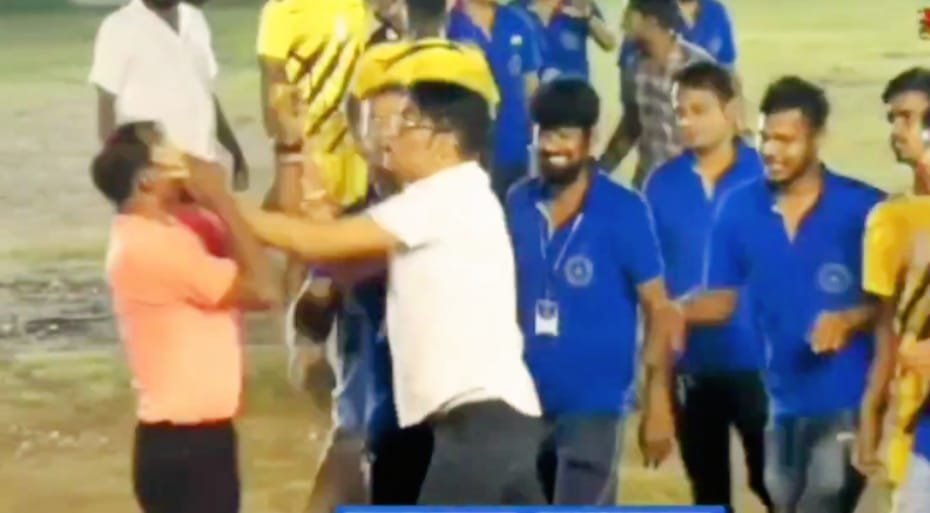
A local football match in Medinipur, West Bengal, descended into chaos on Friday after the nephew of a Trinamool Congress (TMC) leader allegedly stormed the pitch and assaulted the referee, sparking political controversy. The accused, identified as Raja Khan, is the nephew of Soumen Khan, chairman of Medinipur Municipality. Video footage that has since gone viral shows Raja confronting referee Laxman Mandi — a member of the Kharagpur Sub-Division Referees’ Association — before kicking him in the stomach. Spectators and players were seen attempting to restrain him, but to little effect. The altercation reportedly began after a disputed goal, which was later disallowed. Local sources allege that Raja used intimidation to force the decision. Opposition parties have seized on the incident. BJP leader and Leader of the Opposition Suvendu Adhikari shared the video online, drawing parallels with alleged attacks on the Election Commission by Chief Minister Mamata Banerjee. “Attacking referees is part of TMC culture — whether it’s the Election Commission in polls or a referee in a local football match,” he wrote. The ruling party has distanced itself from the incident. TMC spokesperson Arup Chakraborty condemned the assault, calling it “shameful and indefensible,” but argued the party should not be held responsible for the actions of a relative. He drew comparisons with BJP leader Kailash Vijayvargiya’s son, who once attacked a government official with a cricket bat. “There is rule of law in Bengal. Action will be taken,” he said. Even Raja’s uncle, Soumen Khan, disapproved of his conduct. “I was not present at the ground. I condemn this incident in the strongest terms. He may be my nephew, but wrongdoers cannot be spared. He should apologise to the referee immediately,” the civic chairman said. West Bengal Referees’ Association official Chittadas Majumder called the assault “a heinous act,” stressing that violence against referees “cannot be tolerated at any level of the game.” The controversy has further intensified the political sparring in Bengal ahead of upcoming polls, with both the ruling TMC and the opposition BJP trading blame over law, order, and culture in the state.
Melania Trump Sends Personal Letter to Vladimir Putin During Alaska Summit

US First Lady Melania Trump has written a personal letter to Russian President Vladimir Putin, which was handed over by her husband, former US President Donald Trump, during his meeting with the Russian leader in Alaska, according to White House sources. While officials US First Lady Melania Trump has written a personal letter to Russian President Vladimir Putin, which was handed over by her husband, former US President Donald Trump, during his meeting with the Russian leader in Alaska, according to White House sources. While officials declined to reveal the full contents of the letter, it is understood that Mrs Trump raised concerns about the plight of children affected by the ongoing war in Ukraine. She is said to have urged the Russian leader to consider the suffering of minors displaced or separated from their families due to the conflict. The issue of children caught up in the war has long been one of its most sensitive aspects. Kyiv has accused Moscow of forcibly transferring hundreds of thousands of Ukrainian children to Russia or Russian-occupied territories without parental consent, describing the practice as a war crime. Moscow has defended its actions, insisting it relocated vulnerable children from active war zones for their own safety. The United Nations’ human rights office has condemned Russia’s actions, accusing it of violating international law and depriving children of their rights. Friday’s meeting between Mr Trump and Mr Putin, which lasted nearly three hours, did not produce a ceasefire agreement. However, both leaders described the talks as “constructive.” Mr Trump suggested that the next step lay with Ukrainian President Volodymyr Zelensky, advising him to pursue direct negotiations with Moscow. A potential meeting between Mr Putin and Mr Zelensky is now being considered, with Mr Trump indicating he may also be present. Following the Alaska summit, President Putin praised Mr Trump’s “friendly” approach and expressed hope that peace could eventually be restored in Ukraine. Check important plight of children affected by the ongoing war in Ukraine. She is said to have urged the Russian leader to consider the suffering of minors displaced or separated from their families due to the conflict. The issue of children caught up in the war has long been one of its most sensitive aspects. Kyiv has accused Moscow of forcibly transferring hundreds of thousands of Ukrainian children to Russia or Russian-occupied territories without parental consent, describing the practice as a war crime. Moscow has defended its actions, insisting it relocated vulnerable children from active war zones for their own safety. The United Nations’ human rights office has condemned Russia’s actions, accusing it of violating international law and depriving children of their rights. Friday’s meeting between Mr Trump and Mr Putin, which lasted nearly three hours, did not produce a ceasefire agreement. However, both leaders described the talks as “constructive.” Mr Trump suggested that the next step lay with Ukrainian President Volodymyr Zelensky, advising him to pursue direct negotiations with Moscow. A potential meeting between Mr Putin and Mr Zelensky is now being considered, with Mr Trump indicating he may also be present. Following the Alaska summit, President Putin praised Mr Trump’s “friendly” approach and expressed hope that peace could eventually be restored in Ukraine.
Cloud burst, Pakistan floods and landslides kill over 200 as monsoon rains wreak havoc
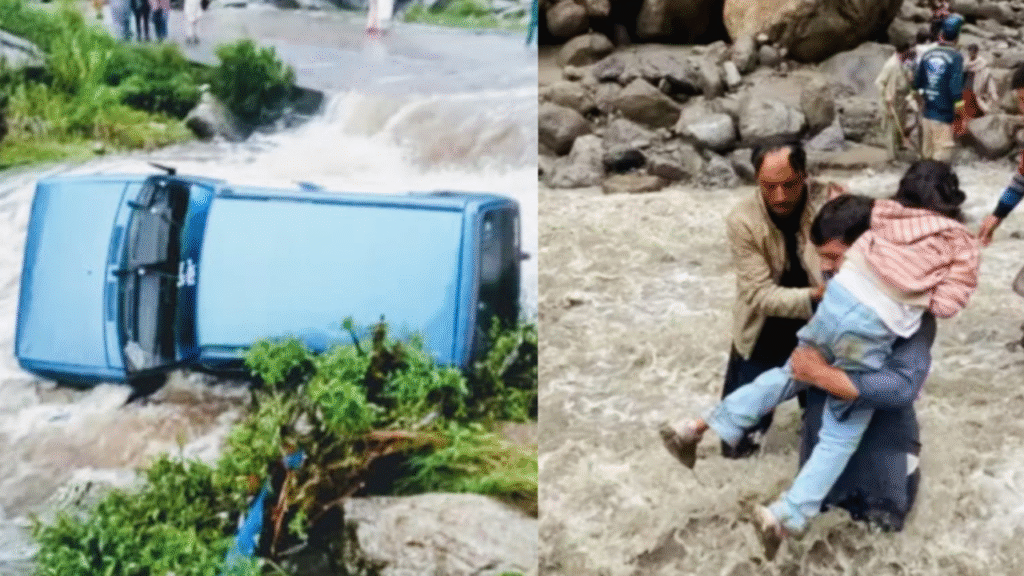
Torrential monsoon rains and flash floods have killed at least 200 people in Pakistan since Thursday, officials confirmed, with the northwestern province of Khyber Pakhtunkhwa bearing the brunt of the disaster. The Urdu service of a news agency, reported that the districts of Buner, Bajaur, and Battagram have been the worst affected. Continuous downpours triggered landslides, swept away homes, and stranded thousands in remote mountain valleys. Helicopter crash during relief mission In one of the most tragic incidents, a military Mi-17 helicopter carrying relief supplies to Bajaur’s Salarzai area crashed in bad weather, killing all five onboard — including two pilots. Provincial disaster management authorities said the aircraft had been assigned to deliver aid to areas cut off by flooding. Whole family killed as houses collapse Authorities in Buner’s Gadezi tehsil reported that 120 people died in that subdistrict alone. In Chagarzai tehsil, an entire family of 22 perished when their home was buried in a landslide. Officials fear many more remain trapped under debris in Higukand and Pir Baba, where floodwaters have engulfed entire neighbourhoods. Al Madina Hotel, a popular local lodging, was completely swept away. The Buner Deputy Commissioner’s office confirmed that while 157 bodies have been recovered, only 78 could be brought to hospitals so far due to road blockages and ongoing landslides. State of emergency under consideration Prime Minister Shehbaz Sharif convened a high-level meeting to review rescue and relief operations. Sources in his office indicated that Khyber Pakhtunkhwa could soon be declared a “disaster-hit zone.” Provincial data shows 189 deaths in the past 24 hours alone — including 163 men, 14 women, and 12 children. In Pakistan-administered Kashmir, at least eight people were killed in landslides, while nearly 500 tourists remain stranded in the Neelum and Jhelum valleys. India’s Jammu and Kashmir also hit Across the border, India’s Jammu and Kashmir reported its own tragedy. In Kishtwar district, cloudbursts and landslides on Thursday killed at least 48 people and injured more than 100. Officials warned the toll could rise as rescue teams, including the army and national disaster response forces, search for the missing in treacherous terrain. Heavy monsoon rains, which typically run from June to September, are becoming more intense in South Asia due to climate change, experts say, making floods and landslides deadlier and more frequent.
Nurse found dead at West Bengal nursing home sparks political protests
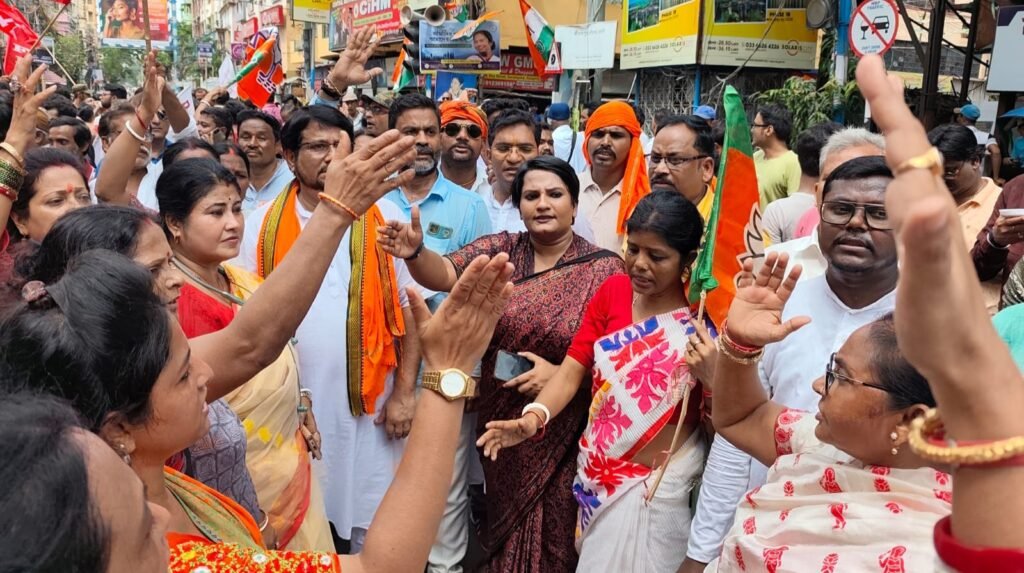
A 24-year-old nurse has been found dead at a nursing home in West Bengal’s Hooghly district, triggering protests and demands for a full investigation. Police said the woman’s body was discovered on Thursday, hanging from the ceiling of a room on the third floor of the facility in Singur. She had joined the nursing home only four days earlier and was a resident of Nandigram in Purba Medinipur district. Her family alleged she was raped and murdered after uncovering irregularities in the running of the nursing home. They also accused police of taking her body for post-mortem examination without informing them. The nursing home’s management has denied the allegations, claiming she died by suicide. The opposition Bharatiya Janata Party (BJP) and the Communist Party of India (Marxist) held demonstrations in the area, accusing the authorities of a cover-up. On Friday, BJP state women’s wing president Falguni Patra joined a protest at Serampore Walsh Hospital, where the body is being kept. State minister and local Trinamool Congress MLA Becharam Manna said action would be taken if police found evidence of foul play. Police have opened an investigation and said they were awaiting the autopsy report before proceeding further.
Burglars Strike Former Swimmer Bula Chowdhury’s Ancestral Home in West Bengal

Burglars have broken into the ancestral home of Padma Shri award-winning former swimmer Bula Chowdhury in Hindmotor’s Debaipukur Road, West Bengal, police said on Friday. The house, which Chowdhury and her family no longer occupy, is mostly vacant and is looked after by her brother, Milan Chowdhury. Milan told local media he discovered a broken rear gate when he visited the property to clean ahead of upcoming festivities. Medals, mementos, bathroom fixtures, and religious items were reported stolen. Chowdhury’s Padma Shri award was not taken, as she keeps it in her Kolkata apartment. “It is painful that medals are being stolen. They have no market value, but they are my life’s achievements,” Chowdhury told the Press. Police from Uttarpara station, led by Inspector-in-Charge Amitava Sanyal, visited the scene. Chowdhury said the same house was burgled about five to six years ago, but no significant recovery was made at that time. No arrests have been made.
Portion of Delhi’s Iconic Humayun’s Tomb Collapses, Killing at Least Five

A section of the 16th-century Humayun’s Tomb — widely regarded by archaeologists as the first major example of Mughal architecture in India — collapsed suddenly on Friday afternoon, leaving at least five people dead and several others trapped under debris. The incident occurred around 4:30pm at the UNESCO World Heritage Site in southeast Delhi’s Nizamuddin East, when part of a dome gave way, according to police. Witnesses said between eight and nine people were caught beneath the rubble, with rescue teams still searching for survivors. Delhi Fire Services told the Press that five bodies have been recovered so far, while fears remain that more victims are buried. Five fire engines and multiple disaster response units were deployed to the site. The collapse happened on a public holiday, when the 450-year-old monument was teeming with visitors. “There were a lot of tourists inside at the time,” a police official told reporters. Humayun’s Tomb, commissioned in 1562 by Hamida Banu Begum — the widow of the Mughal emperor — and designed by Persian architect Mirza Ghiyas, is celebrated as the first garden-tomb in the Mughal tradition. The red sandstone mausoleum not only influenced later Mughal structures, including the Taj Mahal, but also stands as a symbol of the dynasty’s cultural and architectural legacy. The tomb houses the remains of Emperor Humayun, who ruled in two separate stints during the turbulent early years of the Mughal Empire. The emperor’s reign was interrupted after he lost Delhi to Afghan ruler Sher Shah Suri, forcing him into exile. Humayun eventually regained the throne but died in 1556, just a year after his return. India’s Archaeological Survey, which manages the site, has not yet commented on the cause of the collapse. Conservationists have long warned that climate stress, urban pollution, and maintenance lapses could threaten the structural integrity of Delhi’s historic monuments. The tragedy has raised urgent questions about the safety and preservation of India’s cultural heritage.
Mass Nighttime Protests Across West Bengal Over Doctor’s Rape and Murder
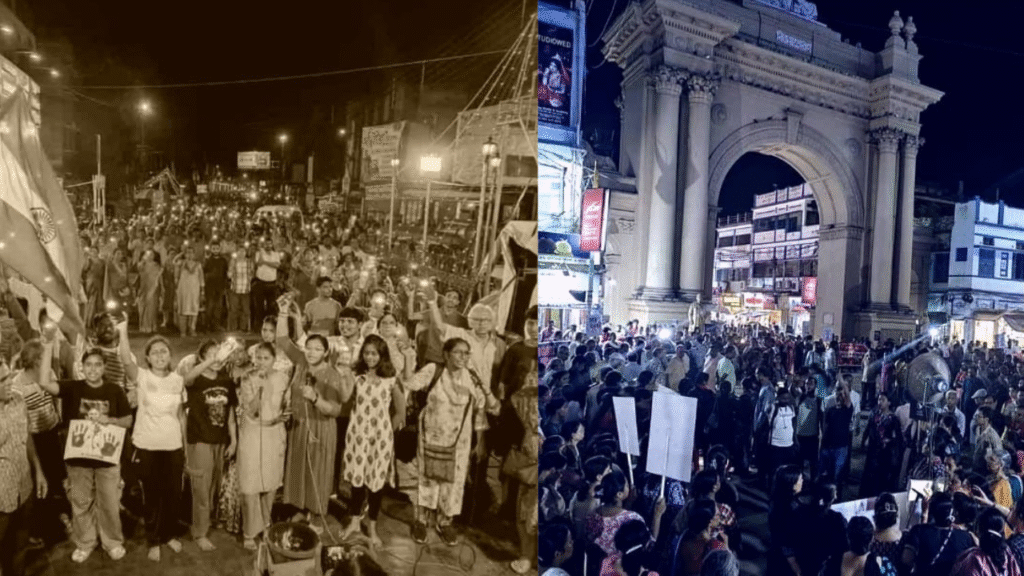
Tens of thousands of people across the Indian state of West Bengal took to the streets on Thursday night in torch-lit vigils and rallies, demanding justice for a young female doctor who was raped and murdered at a Kolkata hospital last year. The “Raatdakhhol” — literally “Night Occupation” — protests were held simultaneously in multiple locations, from Kolkata’s Shyambazar and Jadavpur to towns such as Burdwan, Ghatal, and Medinipur. The movement, spearheaded by a citizens’ collective known as Abhaya Manch (“Fearless Forum”), began exactly a year after a massive outpouring of public anger first swept the city on 14 August 2024. In Kolkata, demonstrators gathered at key intersections — including Shyambazar, Rasbehari Avenue, Lake Town, and Nagerbazar — holding flaming torches, waving national flags, and using mobile phone flashlights to light the night. Many sat in circles on the pavement, reading poetry, staging street plays, and painting protest art on the road. The rallies were not limited to the state capital. In Hooghly district, crowds gathered from Chinsurah to Singur; in Howrah, protesters occupied sites such as Kadamtala and Santragachi; and in Burdwan, people assembled near the historic Curzon Gate. In the southern suburbs, including Behala and Sonarpur, the protests were marked by both large turnouts and political tensions. Organisers accused local leaders from the ruling Trinamool Congress of trying to disrupt the events, a charge the party denied. In Shyambazar, the mother of nine-year-old Tamanna Khatun — killed earlier this year in a bomb attack during a political victory procession in Nadia district — joined the rally, saying she wanted justice not only for her daughter but also for the murdered doctor. Smaller towns such as Ghatal in West Midnapore and Ashoknagar in North 24 Parganas saw late-evening gatherings, with makeshift stages set up for speeches and cultural performances. The original crime — the brutal rape and killing of a junior doctor at RG Kar Medical College in Kolkata — sparked nationwide outrage in 2024, drawing comparisons to the 2012 Delhi gang rape case. The victim’s colleagues have since led repeated strikes, marches, and symbolic occupations, demanding stronger protections for women in the workplace and faster trials in sexual assault cases. On Thursday night, the chants of “We want justice” once again echoed through Bengal’s streets, underscoring the enduring anger and grief that has kept the case alive in public memory.
Air India’s low cost subsidiary Air India Express Expands to 58 Destinations in Major Post-Crash Revival

After June’s deadly crash in Bengaluru cast a long shadow over its operations of Air India , its low cost subsidiary, Air India Express is in expansion mode, signalling a robust revival with the addition of three new cities to its network — Ahmedabad, Chandigarh, and Dehradun. From September 1, 2025, the airline will connect Ahmedabad and Chandigarh to its Bengaluru hub with twice-daily flights, while Dehradun will join the network from September 15 with daily services. The additions will take the carrier’s footprint to 41 domestic and 17 international destinations, its largest network to date. The low-cost arm of Air India, now operating a fleet of 116 aircraft, is positioning itself as India’s fastest-growing airline. The expansion marks a turnaround from the turbulence that followed the Bengaluru crash, in which dozens lost their lives, sparking safety concerns and operational reviews. Industry analysts say the carrier’s rapid return to growth reflects both a strategic push by the Tata Group and increased post-pandemic demand for domestic and regional connectivity. “With our fleet now exceeding 115 aircraft, we continue to build a robust network focusing on connectivity between metros and emerging cities,” said Air India Express Managing Director Aloke Singh. He promised passengers “a warm, reliable flying experience” with enhanced in-flight services and competitive fares, starting from ₹4,100. The new routes cater to both business and leisure travellers: Ahmedabad offers a gateway to Gujarat’s industrial heartland and cultural heritage; Chandigarh serves as the capital of two states and a symbol of post-independence modernism; and Dehradun opens direct access to Uttarakhand’s spiritual centres and Himalayan trekking circuits. Air India Express is also betting on its ‘Xpress Holidays’ platform to drive ancillary revenue, offering bundled packages of flights, hotels, and local experiences. The airline’s fleet features the Tales of India livery, with each aircraft showcasing designs inspired by regional crafts such as Gujarat’s Bandhani, Punjab’s Phulkari, and Uttarakhand’s Aipan art — a branding strategy aimed at deepening its cultural connection with passengers. From Bengaluru alone, Air India Express now operates over 405 weekly flights to 34 domestic and three international destinations, with one-stop connections to an additional 19 cities worldwide. For survivors and families affected by the Bengaluru crash, the expansion is a poignant reminder of how far the airline has come. For the company, it’s a calculated step towards reclaiming market share and restoring public trust — a journey from tragedy to transformation that continues to play out in India’s highly competitive aviation market.


