
Telangana Chief Minister starts training at midnight to face Messi on 13th December!

Telangana Chief Minister Revanth Reddy is known for his ability to maintain strong public relationships. One of the most entertaining personalities in South Indian politics, Revanth Reddy, is also an ardent fan of football. Even during the intense 2023 election campaign, Revanth played a game of football in the old city area despite the business. Nowadays, after becoming the Chief Minister of Telangana, Revanth, still passionate for the game, hardly gets time to enter the pitch wearing a jersey. But Reddy finally got time to prepare himself for a football match despite the business, and this will be the first time he will play after becoming the Chief Minister of Telangana. According to a state ministry source, the C has even started training seriously at midnight, around 11:30 PM, after completing a demanding schedule of official duties. The late-night regimen is in preparation for arguably the most anticipated sports event in the state’s calendar: a friendly exhibition match on 13th December against the Argentine legend Lionel Messi as part of the “G.O.A.T. India Tour 2025. It is going to be a clash of nines and tens as Revanth Reddy will wear the number nine jersey, leading the Team-RR9 against a team captained by Messi, who will don his iconic number 10. The match, set to be held at the Rajiv Gandhi International Stadium in Uppal, is being informally billed as ‘RR9 vs. LM-10’. The chief minister will be playing alongside selected young students from government schools who have demonstrated exceptional football talents. The event is designed to be a lifetime inspiration for these emerging athletes. The exhibition match will serve as the culmination of the Telangana government’s two-year anniversary celebrations (1st December to 13th December), and specifically, the grand unveiling of the Telangana Rising Vision Document 2047 on 9th December.
Sheikh Hasina Sentenced to Death by Bangladesh Tribunal for 2024 Crackdown
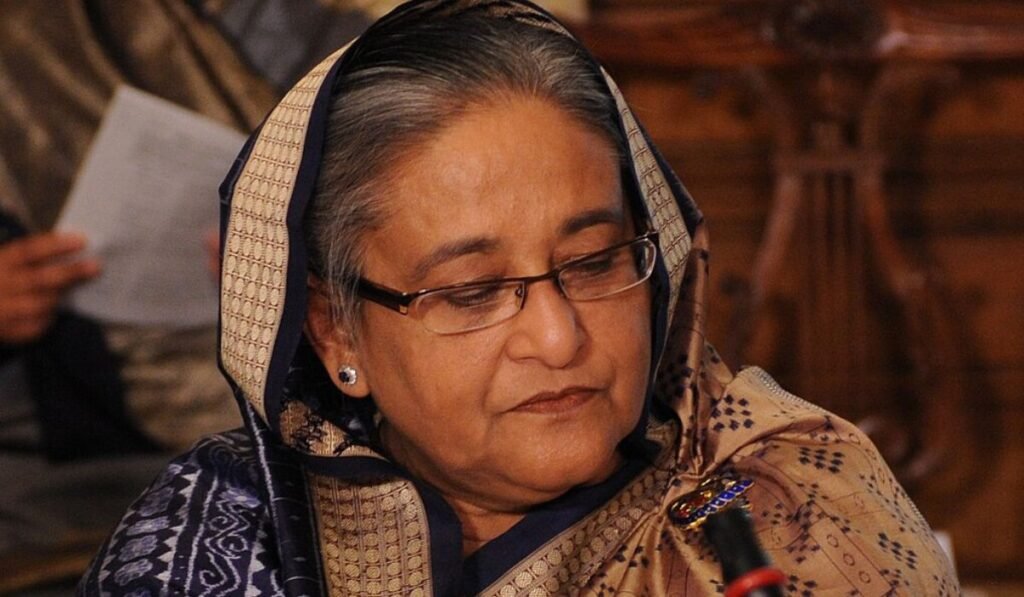
Bangladesh’s International Crimes Tribunal has sentenced former Prime Minister Sheikh Hasina to death after finding her guilty of crimes against humanity for a violent crackdown on student-led protests last year that left more than 1,400 people dead. The 78-year-old, now a fugitive and residing in India, was tried in absentia. Prosecutors alleged that Hasina was the “mastermind and principal architect” of the deadly suppression of mass demonstrations between July 15 and August 5, 2024 — one of the worst periods of political violence since Bangladesh’s 1971 independence war. Courtroom Reaction Live footage from Dhaka showed cheers and applause erupting in the courtroom as the tribunal delivered the death sentence. Security was tight across the capital, with police checking commuters’ belongings and guarding access to the court. Details of the Charges According to the verdict, the tribunal found Hasina guilty of: Ordering lethal force, including the use of drones and helicopters, against protesters. Incitement and failure to take preventive or punitive measures during the killings and mass injuries. Orchestrating actions that were “widespread and systematic” and “directed against the civilian population”. The UN earlier estimated that up to 1,400 people were killed, most by gunfire from security forces, during the 2024 uprising. The interim government led by Nobel laureate Muhammad Yunus, which took power after Hasina’s 15-year rule collapsed in August 2024, denied accusations that the trial was politically motivated. Officials said the proceedings were transparent and monitored by observers. The Foreign Ministry earlier summoned India’s envoy to Dhaka, demanding that New Delhi stop providing Hasina a platform to communicate with the media.Hasina’s son, Sajeeb Wazed, said he had expected the death sentence and claimed his mother was safe under Indian protection. He warned that her supporters would not accept the ruling quietly.The Awami League, now banned from contesting elections, is expected to mobilise large-scale protests, adding further uncertainty as Bangladesh heads toward national polls next year. In an extraordinary twist, the tribunal that sentenced Hasina today is the same court she established in 2010 to prosecute collaborators of the 1971 war. Over the years, the tribunal convicted and executed several opposition leaders — a process critics often called politically motivated.
Top BBC bosses resign after criticism of the broadcaster’s editing of a Trump speech

The head of the BBC and the British broadcaster’s top news executive both resigned Sunday after criticism of the way the organization edited a speech by U.S. President Donald Trump. The BBC said Director-General Tim Davie and news CEO Deborah Turness had both decided to leave the corporation. Britain’s publicly funded national broadcaster has been criticized for editing a speech Trump made on Jan. 6, 2021, before protesters attacked the Capitol in Washington. Critics said the way the speech was edited for a BBC documentary last year was misleading and cut out a section where Trump said he wanted supporters to demonstrate peacefully. A clip of the BBC “Panorama” episode shared by The Daily Telegraph appears to show different parts of Trump’s speech edited into one quote. In the episode, Trump is shown saying: “We’re going to walk down to the Capitol and I’ll be there with you. And we fight. We fight like hell.”According to video and a transcript from Trump’s comments that day, he said: “We’re going to walk down to the Capitol, and we’re going to cheer on our brave senators and congressmen and women, and we’re probably not going to be cheering so much for some of them.“Because you’ll never take back our country with weakness. You have to show strength and you have to be strong. We have come to demand that Congress do the right thing and only count the electors who have been lawfully slated, lawfully slated. “I know that everyone here will soon be marching over to the Capitol building to peacefully and patriotically make your voices heard.” Nearly an hour later, Trump used the phrase “we fight like hell” toward the end of his speech, but without referencing the Capitol. “We fight like hell. And if you don’t fight like hell, you’re not going to have a country anymore,” Trump said then. In a letter to staff, Davie said quitting the job after five years “is entirely my decision.”
Indian-origin businessman shot dead in ‘targeted’ killing in Canada, Lawrence Bishnoi Gang claims responsibility

Punjabi NRI businessman Darshan Singh Sahsi, 68, who was shot dead in Canada in a targeted attack reportedly by the Lawrence Bishnoi-Goldy Brar gang, was best known for his massive business of recycled clothing. But the problem of illicit drugs — particularly the issue of addiction among youth in Punjab — was a crucial focus in his life.And a standout moment came in 2016, when he delivered a speech at the memorium of his nephew. A 68-year-old Indian-origin businessman was shot dead outside his house in Canada’s British Columbia province in a suspected “targeted incident”, according to media reports and police. “I don’t want to hide the truth. My nephew has died of drug addiction,” Sahsi had said in a poignant speech at the gurdwara in his native place Rajgarh near Doraha, 20 km from Ludhiana.At the ‘bhog ardas’ (concluding prayers) for 36-year-old Jagjit Singh Sahsi, who left behind his wife and a daughter barely six years old, Sahsi addressed the grief of a village but also the community’s grave denial. Before Sahsi spoke, politicians had delivered condolence messages without mentioning drugs. Jagjit was reportedly found dead with a packet of ‘chitta’ (smack/heroin) in his hand.
IndiGo Launches First Direct Mumbai–London Heathrow Flight

IndiGo, India’s largest airline, on Sunday operated its inaugural non-stop flight between Mumbai and London Heathrow, marking a major milestone in the carrier’s global expansion strategy. The daily service, operated with IndiGo’s Boeing 787-9 Dreamliner, features a dual-class configuration — standard Economy and IndiGoStretch, the airline’s customized business-class product. Heathrow, one of the world’s busiest airports, is considered a key gateway for international airlines. IndiGo’s new route connects two of the world’s major financial hubs, strengthening ties between India and the United Kingdom. The airline said the service will cater to strong travel demand between the two countries for education, tourism, and family visits. With this launch, Indian travelers will now have the option to fly with IndiGo to London and connect onward through the carrier’s codeshare partners. Similarly, travelers from London will gain direct access to IndiGo’s network of more than 90 destinations across India. “We are delighted to announce the launch of direct connectivity between Mumbai and London — two vibrant, global financial hubs with deep cultural and economic ties,” said Pieter Elbers, IndiGo’s chief executive officer. “This route is not just a new destination for us; it’s a bridge between cultures, businesses, and families.” Elbers added that the new service represents a defining moment in IndiGo’s journey toward becoming a truly global airline, reaffirming its commitment to connecting India to the world through “efficient, consistent, and reliable service.” IndiGo said the new route aims to make travel between India and the U.K. more seamless, accessible, and affordable.
China Consul General Highlights Strengthening India-China Relations, Trade Growth

China and India are witnessing renewed momentum in bilateral relations as trade, investment, and cultural exchanges deepen, said Xu Wei, Consul General of China in Kolkata, during an address titled “China’s Development and China-India Cooperation.” Xu highlighted that both countries, as major emerging economies, have maintained a robust trade partnership with volumes surpassing USD 100 billion for several consecutive years. From January to September this year, bilateral trade reached USD 115.2 billion, up 10.9 percent year-on-year. “The Chinese Embassy and Consulates in India have issued over 280,000 visas to Indian citizens this year,” Xu said. “Our Consulate in Kolkata alone issued 12,717 visas, already exceeding last year’s total. Most of these are business visas, showing strong commercial interest.” He also noted that India has reopened tourist visas for Chinese citizens, while direct flights between the two countries are set to resume after five years. “This Sunday, IndiGo will launch a Kolkata–Guangzhou route. In November, Shanghai–New Delhi and Guangzhou–New Delhi flights will also restart, making travel more convenient and cost-effective,” Xu added. The consul general shared his impressions after visiting Shanghai and Suzhou, describing Shanghai as “a window into China’s modernization” and a leader in international trade, finance, and technology. Shanghai’s GDP crossed 5.39 trillion yuan (USD 757 billion) in 2024 — larger than that of several developed nations. Suzhou, he said, has become a global manufacturing powerhouse with growing trade ties with India, reaching USD 10.16 billion last year. Xu also reviewed China’s 14th Five-Year Plan (2021–2025), emphasizing the nation’s steady economic growth and green development goals. “China’s GDP expanded from 110 trillion to over 134 trillion yuan during this period, growing by an average of 5.5 percent annually despite global challenges,” he said. Renewable energy now accounts for nearly 60 percent of China’s power capacity, and more than half of the world’s new energy vehicles are produced in China. China remains the world’s second-largest economy, with a GDP worth about USD 18.9 trillion — around 17 percent of the global total — contributing roughly 30 percent of global growth. Xu stressed that 2025 marks the 75th anniversary of diplomatic relations between India and China. “President Xi Jinping and Prime Minister Narendra Modi have agreed that our two countries are partners, not rivals, and opportunities, not threats,” he said. Expressing optimism, Xu added, “With the guidance of our leaders and the efforts of our people, I believe China-India relations will continue to improve, bringing tangible benefits to both nations and contributing to peace and prosperity in Asia and beyond.”
Netanyahu ‘determined’ to pressure Hamas to find remaining dead hostages

Israel’s prime minister Benjamin Netanyahu has told a memorial for victims of the Hamas-led attack on 7 October 2023 that he is “determined” to secure the return of the dead hostages still in Gaza, and that the country will continue to fight terrorism with “full force”. Benjamin Netanyahu made the comments hours after Hamas returned the bodies of two more hostages but said it was not able to access the remaining 19. There has been fury in Israel that Hamas has not returned all the bodies in line with last week’s Gaza ceasefire deal, though the US has downplayed the suggestion it amounts to a breach, reports an international media. Also on Thursday, Donald Trump signalled he was willing to see fighting resume if Hamas “continues to kill people”. Earlier on Thursday, the Israeli government confirmed that two bodies handed over by Hamas to the International Committee of the Red Cross on Wednesday night had been identified as Inbar Hayman and Sgt Maj Muhammad al-Atarash. With this, the number of dead hostages returned since Monday has risen to nine out of 28. Meanwhile in Gaza, work is under way to identify the bodies of Palestinians returned by Israel in recent days in exchange for the hostages’ bodies. A further 30 were returned on Thursday, taking the total to 120.
Sinopec seeks govt support to expedite USD 3.7 bn oil refinery construction

Chinese energy giant Sinopec on Wednesday sought the Sri Lankan government’s help in expediting the construction of a USD 3.7 billion oil refinery at the island nation’s strategic Hambantota port, according to a statement. An agreement to build the state-of-the-art oil refinery was signed between the two nations in January during President Anura Kumara Dissanayake’s visit to China. However, its commencement has been slow-going. A delegation of the oil company called on Foreign Minister Vijitha Herath to discuss the slow progress of the project, the Foreign Ministry said in a statement. The delegation, led by the company’s vice president, sought government assistance to iron out remaining difficulties to expedite the work, it said. The refinery, with a capacity of 200,000 barrels per day, is said to become the main attraction at an investment zone around the Chinese-built Hambantota port. China secured a long-term lease to build the economic zone. It also secured the Hambantota port on a 99-year lease as a debt swap.
Trump slaps additional 100 percent tariff on China

Intensifying trade tensions with China, US President Donald Trump announced a 100 percent tariff on Chinese goods in response to Beijing’s export policy of tightening its control over critical minerals and rare earth elements—key resources vital to global technology and defense industries. Trump further clarified on his earlier comments regarding his planned meeting with Xi, saying he had not officially canceled the summit. Trump revealed the tariff increase via Truth Social, stating the new duties would take effect on November 1, or possibly sooner. These tariffs would supersede the existing duties on Chinese goods, which have been in place since the previous trade conflict. Additionally, Trump announced his administration would implement export controls on “any and all critical software,” in response to China’s tightened grip on rare earth exports. “It is impossible to believe that China would have taken such an action, but they have, and the rest is history,” Trump posted on Truth Social. However, he expressed surprise at China’s sudden imposition of the export restrictions, calling them “out of the blue.” Speaking to reporters at the White House, Trump added, “No, I haven’t canceled. However, I’m not sure if we’ll have it. I’ll be there regardless. I would assume we might have it, but they hit the world with something. It was shocking. Out of the blue, they came up with this whole import-export concept, and nobody knew anything about it.” Trump reiterated that the additional tariffs and export controls would be imposed in retaliation for what he described as Beijing’s “extraordinarily aggressive” actions. The tariffs, effective November 1, will target a wide range of Chinese goods, exacerbating the already tense trade relationship between the two nations. Stock markets reacted negatively to the news, with the Nasdaq falling 3.6% and the S&P 500 dropping 2.7 pc. China introduced new restrictions this week that require foreign entities to obtain licenses to export any products containing more than 0.1 percent rare earth elements sourced from or processed in China. China currently controls approximately 70 percent of the world’s supply of rare earth metals, which are essential for a wide range of technologies, from smartphones to military equipment. Currently, Chinese goods face US tariffs of 30 pc, a measure Trump implemented during his first term, accusing Beijing of enabling the fentanyl trade and engaging in unfair trade practices. Earlier in the week, Trump stated there was “no reason to meet” with Xi Jinping after Beijing’s “very hostile” actions regarding rare earth exports. He warned that the US was preparing to respond with “strong countermeasures.” When asked if the US would revoke the additional tariffs if China rolled back its restrictions, Trump responded, “We’ll have to see what happens. That’s why I made it November 1.” Trump also hinted at further export controls, suggesting that aircraft parts could be among the items targeted by the US. “A lot more. We have airplanes and their parts. We were just surprised by China. I have a very good relationship with President Xi, and they did that. This is not something that I instigated. This was just a response to something they did. And they didn’t really aim it at us. They aimed it at the whole world. I thought it was very, very bad,” he said. The tariffs will be in addition to those already in place, marking a significant escalation in the trade standoff. Trump also reaffirmed that export controls on all critical software will begin on the same day.
ECI flags ‘abnormal’ spike in Bengal voters, highest among major states in 22 years
The Election Commission of India (ECI) has put West Bengal under its scanner after identifying an “abnormal” surge of nearly 66 per cent in the state’s voter population between 2002 and 2024, the highest increase among all major states of the country in the last 22 years. The spike, which has been recorded since the last Special Intensive Revision (SIR) of electoral rolls in 2002, will be one of the major concerns for the Election Commission of India during the SIR scheduled to take place in West Bengal shortly, ahead of the 2026 Assembly elections. Senior officials in the poll panel indicated that the revision could significantly prune the electoral rolls, especially with a focus on deleting names of deceased and shifted voters. “A logical growth in the number of voters should have been in the range of 48 to 50 per cent during this period. Bengal has recorded 65.8 per cent, which is much above the national trend. This abnormal growth will definitely attract the Commission’s attention,” a senior official in the Chief Electoral Officer’s office said on condition of anonymity. According to ECI’s comparative data of major states between 2002 and 2024, Bengal’s increase of 65.8 percent dwarfs that of states with far larger populations. Uttar Pradesh registered a 39.1 per cent increase, Madhya Pradesh 47.2 percent, Maharashtra 44.8 percent, Karnataka 28.7 percent, Tamil Nadu 18.8 percent, Bihar 50.3 percent crore, and Gujarat saw a 42.2 percent increase. In absolute terms, Bengal had 4.58 crore voters in 2002 following the last SIR, which has now increased to 7.60 crore in 2024. Poll officials argued that such sharp growth is unlikely to be explained by demographic changes alone. “The abnormal rise is primarily because booth-level officers (BLOs) failed to delete the names of the deceased and those who migrated. During the last intensive revision in 2002, over 28 lakh names were deleted. A similar exercise now will definitely cut down the rolls,” the official added. The issue comes against the backdrop of the Supreme Court hearing challenges to a similar SIR ordered in Bihar, where petitioners fear that nearly 3 crore people particularly from marginalised groups could lose voting rights. In Bengal too, the debate has already acquired sharp political tones. The BJP has claimed that the spike indicates large-scale inclusion of “illegal infiltrators” from Bangladesh and demanded that the Commission act decisively. “In the past few years, Assembly segments in border areas like Rajarhat-Gopalpur, Bongaon, Barasat and parts of Nadia have seen a 16 to 18 per cent jump in voters. We estimate that around one crore infiltrators could be identified if a proper SIR is conducted,” a state BJP functionary said on condition of anonymity. Chief Minister Mamata Banerjee and the ruling Trinamool Congress, however, dismissed the BJP’s claims and suggested that the exercise was politically motivated. At a recent press conference, Mamata described the Bihar SIR as “worse than an NRC update” and warned that Bengal could be the “actual target.” Within the administration, the ECI has already directed district election officers to ensure that BLOs who are state government employees are appointed from Group C and above, to ensure accountability. A recent special summary revision in Nadia’s Kaliganj Assembly seat saw 8,000 deletions from the rolls without any controversy, which officials cite as proof that genuine voters will not be affected. The CEO’s office official emphasised, “The Commission will not allow any laxity in cleaning up the rolls. We are committed that no genuine voter will be deleted in the process”. As Bengal heads towards its next Assembly polls in 2026, the question of how the “abnormal” 66 per cent growth in its electorate will be addressed promises to be one of the most contentious issues in the state’s political landscape.


