
Prime Minister Leads Largest-Ever Trade Mission to India

United Kingdom Prime Minister Keir Starmer arrived in Mumbai yesterday, leading the country’s largest-ever trade mission to India with a 125-member delegation of CEOs, entrepreneurs, university vice chancellors and cultural leaders. The two-day visit aims to strengthen post-trade deal momentum between the two countries, following the landmark UK-India trade agreement signed in July. The pact, hailed as the most comprehensive deal India has struck with any nation, will slash tariffs and boost market access for British companies across sectors. Major firms including Rolls-Royce, British Telecom, Diageo, London Stock Exchange, and British Airways are accompanying Starmer as part of efforts to unlock investment opportunities and promote growth in both economies. “This isn’t just a piece of paper — it’s a launchpad for growth,” Starmer said. “With India set to become the world’s third-largest economy by 2028, the opportunities for British business are unparalleled.” Business and Trade Secretary Peter Kyle called the agreement “the best any country has ever secured with India,” noting it would place British firms “at the front of the queue” in one of the world’s fastest-growing markets. The trade deal is projected to increase annual bilateral trade by £25.5 billion, with UK exports to India expected to grow nearly 60 percent. Tariffs on British goods will fall from an average of 15 percent to 3 percent, while duties on whisky will be cut from 150 percent to 75 percent immediately and then reduced further to 40 percent over a decade. British Airways announced it will add a third daily Delhi–London flight by 2026 to meet rising demand, while Manchester Airport will introduce a new IndiGo-operated route to Delhi, generating an estimated £75 million in exports and tourism annually. “British Airways sits at the center of increased UK-India economic activity,” said the airline’s CEO Sean Doyle. “The free trade agreement will strengthen ties built over a century.” Fourteen UK university vice chancellors are also part of the mission, reflecting growing education partnerships as India looks to create 70 million higher education seats by 2035. Cultural leaders from institutions such as the British Film Institute and National Theatre are exploring collaborations in film, heritage, and creative industries. The visit follows Indian Prime Minister Narendra Modi’s trip to London in July, which resulted in £6 billion in new investments and export wins. Starmer is expected to meet Modi again on Thursday to discuss expanding cooperation in technology, defense, and telecom under the UK-India Technology Security Initiative. India’s tech sector, projected to reach £1 trillion in value by 2030, remains a key focus of the partnership. “We’re determined to seize the new opportunities this deal creates,” Starmer said. “Growth in India means jobs and prosperity at home.”
Left Front stages protest rally in Kolkata against Israeli actions in Gaza

Kolkata witnessed a massive rally on Saturday as the Left Front and its affiliated organisations marched from Rabindra Sadan to Lenin’s Statue at Esplanade, raising their voice against the recent Israeli attack on a humanitarian aid flotilla bound for Gaza. The protesters also demanded the immediate release of internationally renowned activists, including environmentalist Greta Thunberg, who have reportedly been detained for standing in solidarity with the Palestinian cause.The rally, called by Left parties, was marked by a sea of banners, posters and placards condemning Israel’s actions. The demonstrators carried slogans demanding an immediate end to what they described as “genocide in Gaza” and condemned the United States for providing continuous support to what they termed “war crimes” by Israel. Senior Left leaders, including Left Front chairman Biman Bose, CPI(M) central committee member Sujan Chakraborty, and Students’ Federation of India (SFI) general secretary Srijan Bhattacharya, were present at the forefront of the rally. They walked shoulder to shoulder with a large number of activists, students, workers, and common citizens who had gathered in solidarity with the people of Palestine. Speakers at the rally strongly criticised the Israeli government for launching repeated assaults on civilian populations in Gaza, as well as the attack on the flotilla carrying humanitarian aid. “The attack is not only an assault on the people of Gaza but also on international humanitarian principles,” Sujan Chakraborty said. He further alleged that such actions were possible only because of unconditional backing from the United States, which continues to shield Israel on international platforms. The rally reiterated the student community’s solidarity with the Palestinian people and demanded the immediate release of Greta Thunberg and other activists who had stood up against what they called “ecological destruction and human rights violations in the name of war.” The rally saw hundreds of participants chanting slogans such as “Stop genocide in Gaza,” “Free the detained activists,” and “Down with US-backed Israeli war crimes.” The protest concluded at Lenin’s statue in Esplanade, where participants took a pledge to continue mobilising public opinion in support of Palestine. The leaders announced that similar rallies and meetings would be held across districts in West Bengal in the coming days to sustain the momentum.
Sanae Takaichi Set to Become Japan’s First Female Prime Minister After Winning LDP Leadership

Sanae Takaichi was elected Saturday to lead Japan’s ruling Liberal Democratic Party, positioning her to become the country’s first female prime minister. Takaichi, 64, a former economic security minister known for her right-leaning views, defeated Shinjiro Koizumi, the son of former Prime Minister Junichiro Koizumi, in a runoff after none of the five candidates secured a majority in the first round of voting. Koizumi, 43, would have been Japan’s youngest prime minister in more than a century if he had won. The parliamentary vote to formally select Japan’s next prime minister is expected on Oct. 15. As the LDP remains the largest party in parliament, Takaichi is expected to succeed Prime Minister Shigeru Ishiba. Saturday’s vote included 295 LDP lawmakers and about 1 million dues-paying party members, representing roughly 1% of Japan’s population. Takaichi will face significant challenges once in office, including a rapidly aging population, sluggish economic growth, rising geopolitical tensions, and increasing debate over immigration policy. Although the LDP retains the largest bloc in the Diet, the ruling coalition lost its majority in both chambers in recent elections. To govern effectively, Takaichi’s administration will likely seek to strengthen its alliance with the moderate Komeito party and reach out to centrist opposition groups. Takaichi’s election marks a historic moment for Japan, which has never before had a woman serve as prime minister in its postwar history.
Airspace violations force NATO to tread a tightrope, deterring Russia without hiking tensions

NATO is stepping up aerial surveillance in the Baltic Sea, while France, Germany and Sweden are bolstering Denmark’s air defenses ahead of two summits in Copenhagen this week over a series of troubling drone incidents near the country’s airports and military bases. The number of serious airspace violations in Europe has spiked this month, including by Russian warplanes. But not all NATO allies agree on how to respond. Poland is ready to use lethal force. Others say that must only be a last resort. Regardless of who is to blame in Denmark, European leaders believe that Russia is testing NATO. Military planners in Moscow can observe how Western forces react, and countering intrusions by relatively cheap drones is a financial burden on the allies. In the wake of the drone incident in Poland, NATO launched operation Eastern Sentry, with Britain among the allies to send more air defense equipment. However, these deployments might also deprive Ukraine of the air defense systems it badly needs from its allies. NATO must tread a tightrope in its response. Poland’s message is blunt. It intends to shoot down intruders over its territory. “If another missile or aircraft enters our space without permission, deliberately or by mistake, and gets shot down and the wreckage falls on NATO territory, please don’t come here to whine about it,” Polish Foreign Minister Radek Sikorski told Russia’s U.N. delegation last week. “You have been warned.” Poland activated its air defenses over the weekend during a major Russian attack on Ukraine. Defense is a national prerogative, even within the world’s biggest military alliance. Poland or Finland, say, might use force to defend their territory. U.S. President Donald Trump has agreed that European countries should be able to shoot intruders down. The responsibility for that act would lie with the nation concerned. NATO, though, is likely to be more cautious in any joint operation using aircraft and equipment drawn from across the 32-country alliance. “We have to act decisively and quickly,” NATO Secretary-General Mark Rutte said last week, but he underlined that it’s important to “always assess the threat levels” to see whether force is necessary.
At least 3 killed in clashes in Bangladesh’s Khagrachhari amid protests
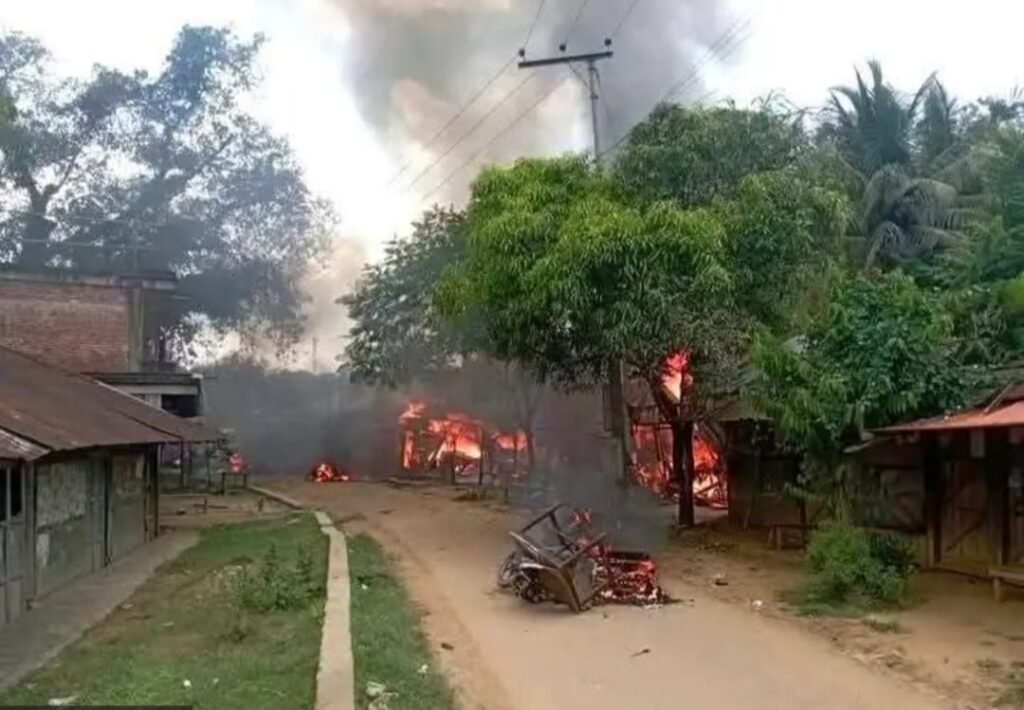
At least three people were killed and several others injured Sunday in heavy gunfire and clashes in Khagrachhari, a hill district in southeastern Bangladesh, officials said. The violence erupted in Guimara subdistrict during protests over a reported rape case, despite emergency restrictions imposed under Section 144. The Home Ministry said in a statement that a major and 12 other army personnel, the officer-in-charge of Guimara police station along with two other policemen, and several civilians were wounded in the unrest. Authorities expressed sorrow over the deaths and vowed that those responsible would face legal action. “No perpetrator will be spared,” the ministry said. Following the clashes, images and videos circulated on social media showing fires at shops and buildings in Ramsu Bazaar, a marketplace known to the Marma community. Activists linked to the Jumma Students’ Movement alleged that homes and shops belonging to hill people were torched. Local Bengali groups, however, blamed armed ethnic organizations for the violence. Reports that army personnel had been attacked circulated widely online in the early afternoon, though neither the Inter-Services Public Relations (ISPR) nor district officials confirmed those claims. Khagrachhari’s deputy commissioner, A.B.M. Iftekharul Islam Khondker, told the BBC that he and the superintendent of police had tried to reach Guimara after the violence began, but road blockades by protesters prevented them from arriving by 5 p.m. Later in the evening, regional police chief Ahsan Habib Palash said the situation was “under control.”
Indian who arrived in US illegally arrested for causing multi-vehicle crash in California

An Indian national, who had arrived in the US illegally, has been arrested for causing a multi-vehicle crash while driving a truck in California last year that critically injured a five-year old child and left her with life-altering injuries. The US Immigration and Customs Enforcement (ICE) arrested Partap Singh last month and he will remain in ICE custody pending immigration proceedings. The agency said that in June 2024, Singh caused a multi-car pileup while driving a commercial 18-wheeler in California.
Russian Deputy PM Patrushev calls on PM Modi
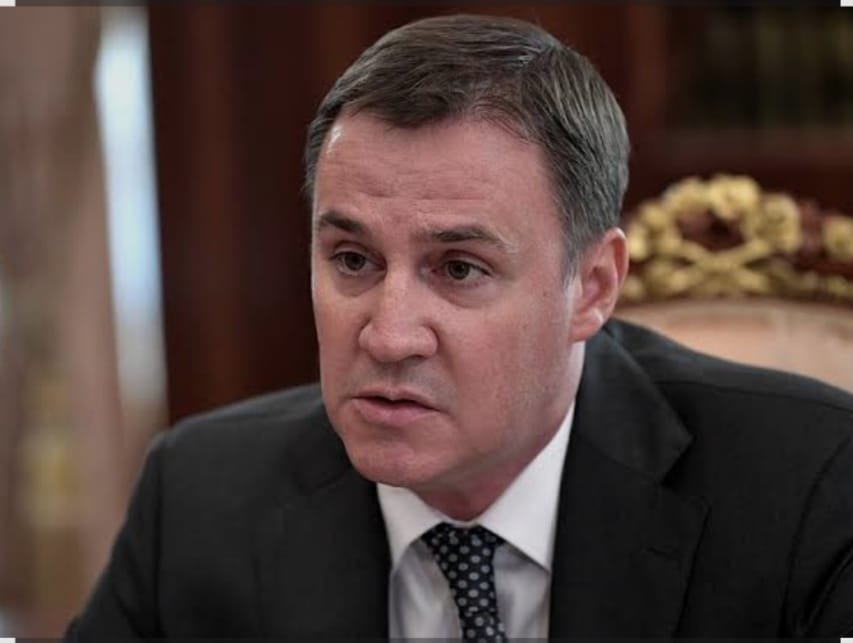
Russian Deputy Prime Minister Dmitry Patrushev called on Prime Minister Narendra Modi and exchanged views on enhancing cooperation in agriculture, fertilisers, food processing and other areas of mutual interest. Patrushev is currently on a visit to India as part of preparations for the visit of Russian President Vladimir Putin to India in December.” They exchanged views on enhancing cooperation in agriculture, fertilizers, food processing and other areas of mutual interest,” the Ministry of External Affairs (MEA) said on Patrushev’s meeting with Modi on Thursday.
Monks protest at Bangladesh Deputy High Commission in Kolkata over idol vandalism

Several Hindu organizations led by Mahamandaleswar Swami Paramatmananda Bhairav, Bengal head of Sri Panchayeti Mahanirbani Akhada in Bengal staged a demonstration outside the Bangladesh Deputy High Commission in Kolkata, protesting the reported vandalism of a Durga idol at Kashim Pure in Bangladesh. The protestors gathered near the mission, chanting slogans and demanding immediate steps to ensure the safety of Hindus in Bangladesh. The groups also submitted a deputation to Deputy High Commissioner officials, urging action and protection for minorities in the neighboring country. In a memorandum handed to the mission, the signatories including Swami Ranjitananda Giri, Mahamandaleswar of Juna Akhada condemned what they described as a “shocking act of intolerance” that deeply hurt the sentiments of Hindus. “This incident has caused widespread anguish among peace-loving people,” the letter stated. “The deputation laid out three key demands: swift punishment for those responsible for the vandalism, preventive measures to safeguard minority communities and their places of worship, and guarantees of security during religious and cultural festivals,” said Swami Paramatmananda Bhairav. Protestors said the targeting of Durga idols, particularly ahead of the upcoming festival season, was alarming and risked sparking further tensions. “We strongly urge the Bangladesh authorities to ensure that Hindus can celebrate their traditions without fear,” one protestor told reporters. The memorandum was also marked to the Ministry of Foreign Affairs in Dhaka, the Indian Prime Minister’s Office, the Union Home Minister, the External Affairs Minister, the West Bengal government, and the Governor of West Bengal. Organizers said the protest was not only about the Kashim Pure incident but about a broader pattern of alleged attacks on minorities across Bangladesh. They appealed for bilateral intervention to protect religious harmony. There was a strong police presence around the mission to ensure order, and the demonstration remained peaceful. The Bangladesh Deputy High Commission had not immediately responded to the deputation. However, officials have previously said that the government in Dhaka is committed to protecting minority rights and punishing offenders involved in communal violence. For now, Hindu groups in Kolkata say they will continue to monitor the situation and press for assurances that such incidents will not be repeated.
Acting Chinese Consul General Attends Session on New Framework of China-India Relations in Kolkata
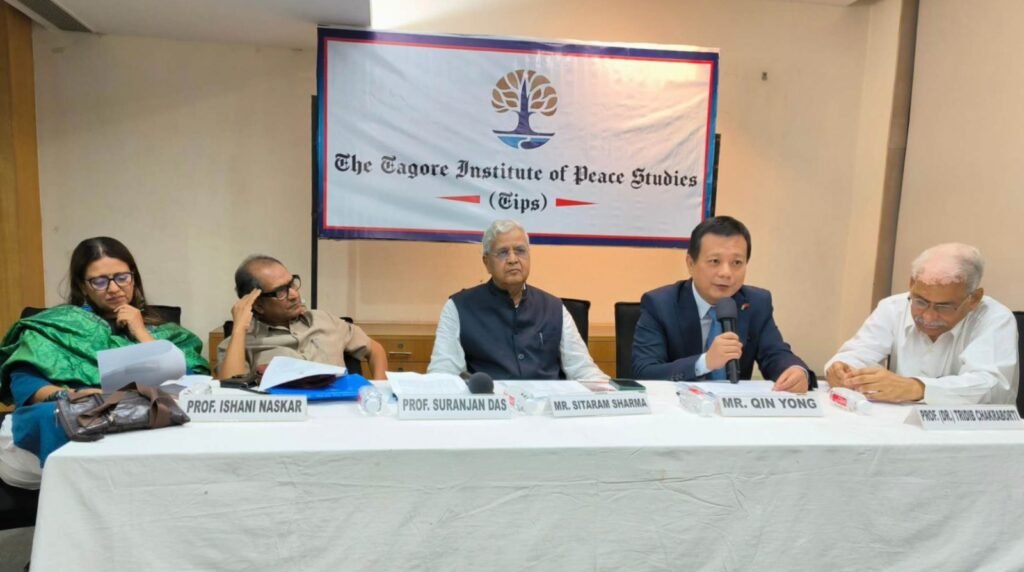
The Consulate General of China in Kolkata and the Tagore Institute of Peace Studies (TIPS) jointly organized an exclusive session on “Shifting Geopolitics: New Framework of China-India Relationship” in Kolkata, where Acting Consul General Qin Yong delivered the keynote address. The session brought together more than 60 participants from think tanks, universities, media houses and other institutions. Among the distinguished speakers were TIPS Founder President Sitaram Sharma, Adamas University Vice Chancellor Prof. Suranjan Das, Prof. Tridib Chakraborti of Adamas University and Prof. Ishani Naskar of Jadavpur University. Joining virtually from China were Prof. Zhang Jiadong of Fudan University and Prof. Huang Yunsong of Sichuan University. In his address, Qin highlighted the new consensus reached between Chinese President Xi Jinping and Indian Prime Minister Narendra Modi during their recent meeting in Tianjin. He also reviewed the key outcomes of the Shanghai Cooperation Organization (SCO) Tianjin Summit and elaborated on the significance of the Global Governance Initiative (GGI) proposed by President Xi. Qin said the leaders’ meeting and the results of the SCO Summit have opened new opportunities for China and India to strengthen cooperation, manage differences and work toward common development. He emphasized that the Consulate General is ready to enhance exchanges across academic, cultural and economic fields in eastern India to advance China-India friendship. Experts and scholars at the session echoed similar views, noting that the long-standing friendship between China and India reflects the aspirations of both peoples. They called for expanding economic and trade cooperation, boosting people-to-people exchanges and encouraging dialogue between civilizations. Speakers also noted that the Global Governance Initiative aligns with the needs of the current era, providing a framework for emerging economies like China and India to cooperate on global challenges. They stressed the importance of closer coordination between the two countries within international multilateral platforms to safeguard their common interests. The dialogue in Kolkata underscored the importance of academic and policy exchanges at a time of shifting global geopolitics. Organizers said such platforms can help foster better understanding, reduce tensions and explore new avenues of partnership between Asia’s two largest neighbors.
Nepal Airlines to Launch First Direct Kathmandu-Guangzhou Flights Sept. 25

Nepal’s national carrier will launch its first-ever direct flights between Kathmandu and Guangzhou, China, later this week, expanding connectivity between the Himalayan nation and one of China’s largest commercial hubs. Nepal Airlines Corporation (NAC) announced Sunday that the Kathmandu-Guangzhou-Kathmandu service will begin Thursday, Sept. 25. The airline will operate three flights a week on the route — every Sunday, Tuesday and Saturday — following the inaugural flight. “All necessary preparations have been completed, and we are ready to commence the Kathmandu-Guangzhou flights,” Manoj Kumar Shah, spokesperson for NAC, said in a statement. The initial two flights are scheduled for Sept. 25 and Sept. 28 before the regular thrice-weekly service begins. The state-run carrier has set one-way fares from Kathmandu to Guangzhou at 30,000 Nepalese rupees (about $225) and round-trip tickets at 50,000 rupees (about $375). The new route places NAC in direct competition with Himalaya Airlines, a private Nepali carrier that already operates regular flights between Kathmandu and Guangzhou, and China Southern Airlines, which connects Guangzhou and Kathmandu. Aviation analysts say the addition of NAC flights will provide passengers more options and may help reduce airfare on the busy China-Nepal route, which has grown in demand due to trade, tourism and educational exchanges. With Guangzhou added to its network, Nepal Airlines now operates regular flights to 11 destinations across nine countries, including India, Malaysia, Japan, the United Arab Emirates and Saudi Arabia. The flag carrier has long sought to expand its international footprint, but competition from private airlines and operational challenges have limited its growth. The Kathmandu-Guangzhou service is being launched at a time when Nepal is working to attract more Chinese tourists and strengthen economic ties with Beijing. China is Nepal’s second-largest source of foreign visitors after India. NAC officials said they are optimistic the route will help boost tourism, especially ahead of the upcoming holiday season, and improve Nepal’s access to southern China’s thriving commercial and industrial region. “This is a milestone for Nepal Airlines and for the country’s aviation sector,” Shah said. “We believe the service will benefit travelers, traders and the tourism industry alike.”


