
IIT Kharagpur study warns climate extremes will hit young and elderly hardest

Extreme weather events are becoming more frequent, more intense and will affect people very differently depending on their age and where they live, according to a new study by researchers at the Indian Institute of Technology Kharagpur. The study, led by Prof. Rajib Maity of the civil engineering department, combined detailed climate projections with demographic data to compare the recent past (1991–2020) with the near future (2021–2050) under various warming and population growth scenarios. Researchers examined how heat waves and cold waves can overlap with heavy rainfall or prolonged dry spells. They found that concurrent extremes — such as heat waves occurring alongside floods or droughts — are projected to rise sharply worldwide. Asia and Africa are expected to be the hardest hit, with children and working-age adults facing the greatest risks. The study warned that sub-Saharan Africa will see the highest exposure for young people because of rapid population growth, while in Europe, North America and Australia, the elderly are most vulnerable — especially to heat waves combined with heavy rainfall. “Europe, in particular, is expected to see the highest exposure levels for seniors globally, raising urgent concerns for healthcare and social care systems,” the researchers said. The study also projected that while cold extremes will decline in tropical regions, they will increase in parts of North America, northern Europe and East Asia. That trend could create the dual threat of more frequent heat waves alongside persistent cold spells. One of the key findings is that climate change is the primary driver of rising exposure globally. In developing regions, population growth is expected to magnify the risks, while in Europe and parts of Asia, where populations are stable or shrinking, climate change alone accounts for most of the increase. A spokesperson for IIT Kharagpur said the research stands out because of its age-specific approach. “Unlike most climate studies that treat populations as a single group, this study disaggregates exposure across children, youth, adults, and seniors,” the spokesperson said. “This reveals the unequal burden of climate extremes and underscores the need for region-specific and age-specific adaptation strategies.” The findings underline the urgent need for adaptation measures and resource policies that protect vulnerable groups, such as children in sub-Saharan Africa and the elderly in Europe, as the effects of climate change intensify worldwide.
BENGALURU POLICE RECOVER ₹14 LAKH LOST IN ‘DIGITAL ARREST’ FRAUD

Bengaluru police have recovered ₹14 lakh that BJP Chikkaballapura MP K. Sudhakar’s wife, Preeti, lost in a cyber fraud involving a scheme known as “digital arrest,” officials said Tuesday. According to police, the incident took place on Aug. 26, when Preeti, 44, a resident of Basaveshwaranagar, received a WhatsApp video call from fraudsters posing as Mumbai Cyber Crime Police officials. The callers told her money had been illegally transferred from her account and demanded that she send funds to the Reserve Bank of India for “verification.” They claimed the money would be returned within 45 minutes but threatened that she would be arrested if she failed to comply. “By threatening, they got a total of ₹14 lakh transferred from the complainant’s HDFC Bank account to an unknown YES Bank account and committed fraud,” police said in a statement. Preeti lodged a complaint the same evening and also contacted the National Cybercrime Reporting Portal helpline number 1930 within the so-called “Golden Hour,” police said. A case was registered and investigators worked to freeze the account where the money was transferred. On Sept. 3, the 47th Additional Chief Judicial Magistrate Court directed YES Bank authorities to return the frozen funds to the complainant. Acting on the order, the full amount was restored to Preeti’s account. Deputy Commissioner of Police (West Division) Girish S. said efforts are underway to trace the fraudsters. He urged the public not to panic in similar situations and to immediately call the cyber helpline. “If a complaint is lodged within the Golden Hour with the National Cyber Helpline 1930, and a case is registered at the nearest police station without delay, prompt action can be taken to prevent losses,” Girish said. Police said “digital arrest” scams have emerged as a new form of cybercrime in which fraudsters impersonate law enforcement or enforcement agencies through video calls and coerce victims into transferring money.
Very heavy rain paralyses Kolkata; three electrocuted
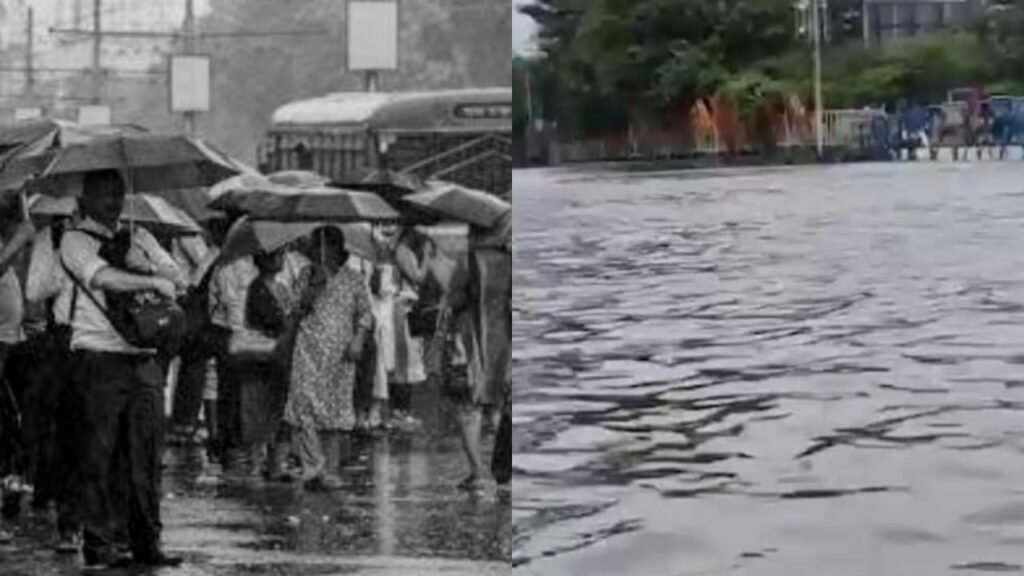
Kolkata reeled under torrential overnight rain on Tuesday, with at least three people dying of electrocution in waterlogged areas. The downpour, which began past midnight, inundated major roads and residential complexes, crippling traffic and public transport. Metro services were suspended between Shahid Khudiram and Maidan stations due to waterlogging, while truncated services ran on other stretches. Eastern Railway suspended train movement in Sealdah’s south section and partially in north and main sections, with services from Howrah and Kolkata terminals also hit. Circular Railway was shut after tracks were flooded at Chitpur yard. Vehicles were stranded for hours in knee-to-waist-deep water at Park Circus, Gariahat, Behala and College Street, while long jams were reported on EM Bypass and AJC Bose Road. Many buses broke down and taxis stayed off the road or overcharged. Several schools declared holidays. According to the KMC, Garia Kamdahari received the highest rainfall at 332 mm, followed by Jodhpur Park (285 mm), Kalighat (280 mm), Topsia (275 mm), Ballygunge (264 mm) and Thantania (195 mm). The IMD warned of more heavy rain in south Bengal districts including Purba and Paschim Medinipur, South 24 Parganas, Jhargram and Bankura, with another low-pressure system likely to form over the Bay of Bengal by September 25.
Burdwan University Standoff: VC Locks Registrar’s Chamber Amid Extension Row
In an unusual standoff at Burdwan University, Vice Chancellor Shankar Kumar Nath on Monday locked the chamber of Registrar Sujit Kumar Chowdhury, accusing him of trespassing and illegally occupying the post despite his retirement in January. The confrontation escalated after Chowdhury filed a police complaint against the vice chancellor, alleging he was unlawfully prevented from carrying out his duties. Chowdhury said the state higher education department had granted him an extension in September, allowing him to resume his role as registrar. Nath, however, disputed the claim, saying he had received no official communication about Chowdhury’s extension or reinstatement. “He (Chowdhury) entered the chamber forcefully without following any rules and his conduct is hampering the activities of the university,” the vice chancellor said. Chowdhury countered that he held documentary proof, including an email from the department, confirming his extension. He said he rejoined the post on Sept. 9 after notifying the vice chancellor in writing. Chowdhury had officially retired from the registrar’s post on Jan. 31 but requested an extension from the higher education department. He said the request was approved last month, but the vice chancellor refused to recognize his return. Nath had earlier lodged a separate police complaint against Chowdhury on Sept. 20, charging him with forcefully occupying the office. Police said both complaints are under review.
Ex-Trinamool Councillor Detained at Kolkata Airport With Firearm

Former Trinamool Congress councillor Sheikh Amirul Islam was detained at Netaji Subhas Chandra Bose International (NSCBI) Airport in Kolkata on Monday after Central Industrial Security Force (CISF) personnel recovered a firearm and six rounds of cartridges from his luggage. Islam, a former councillor of Ward 14 in Pujali, was stopped during security checks when the weapon was detected in his bag. He was immediately handed over to NSCBI police station for further questioning. According to police sources, Islam claimed he possesses a valid license for the firearm. However, officers said he failed to produce the document at the time of detention. A general diary has been lodged in connection with the incident, and the case has been forwarded to court. Police have asked Islam to furnish the license within seven days. If he fails to do so, legal proceedings are likely to follow. The incident has drawn attention as Islam is a known figure in local politics, having served as a Trinamool councillor in Pujali municipality. While police said preliminary inquiry suggests the firearm may have been legally owned, carrying it into the airport without proper clearance has triggered the investigation.
Supreme Court order compels Bengal primary teachers to clear TET for job, promotion
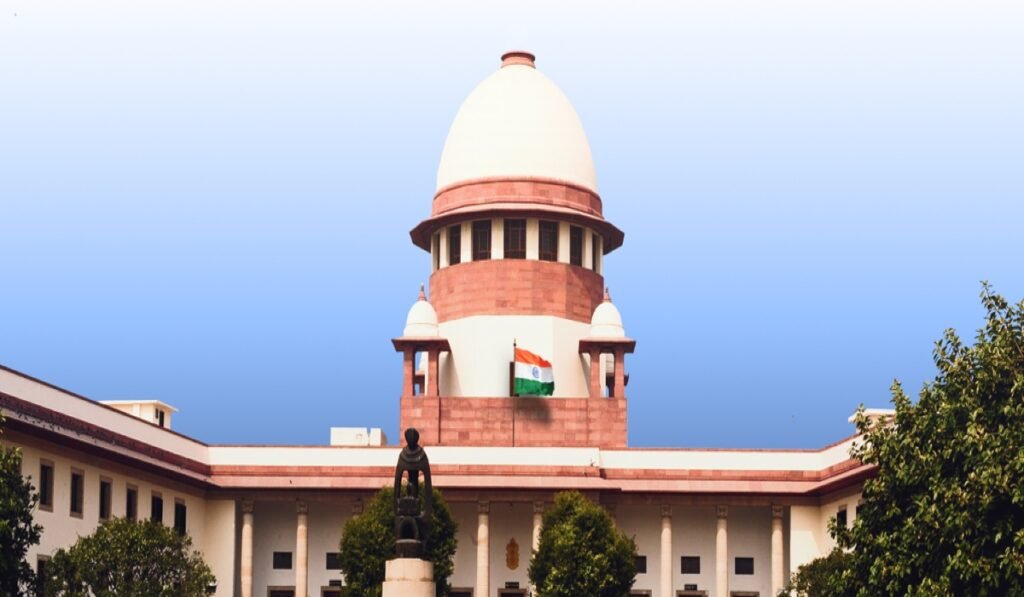
Thousands of primary teachers in West Bengal face uncertainty after the Supreme Court ruled that clearing the Teacher Eligibility Test (TET) is mandatory not only to continue in service but also to secure promotions. Following the directive, the West Bengal Board of Primary Education on Monday issued a circular asking district primary school councils (DPSCs) to submit detailed information on teachers within 15 days. The data sought includes the number of teachers who have yet to clear TET, their date of joining, and retirement schedules. The order affects nearly 150,000 primary school teachers in the state. Those who have not cleared TET will have to appear for the exam again. Earlier this month, a division bench of Justices Dipankar Datta and Augustine George Masih ruled that teachers with more than five years of service must qualify in TET to continue teaching. The court said that those unwilling or unable to pass may resign or opt for compulsory retirement with terminal benefits. Teachers due to retire within the next five years, however, are exempt. The ruling has triggered widespread concern among educators. “Neither the Right to Education Act nor NCTE rules mention such a condition. Yet the Supreme Court has issued this verdict,” said Swapan Mondal, general secretary of the Bengal Teachers and Employees Association. “We immediately wrote to both the Union education minister and the state education minister seeking intervention. The primary board has acted, but the secondary board remains silent. We expect quick action.” The move is likely to affect a significant portion of Bengal’s teaching community, with many fearing job insecurity even after years of service.
Acting Chinese Consul General Attends Session on New Framework of China-India Relations in Kolkata
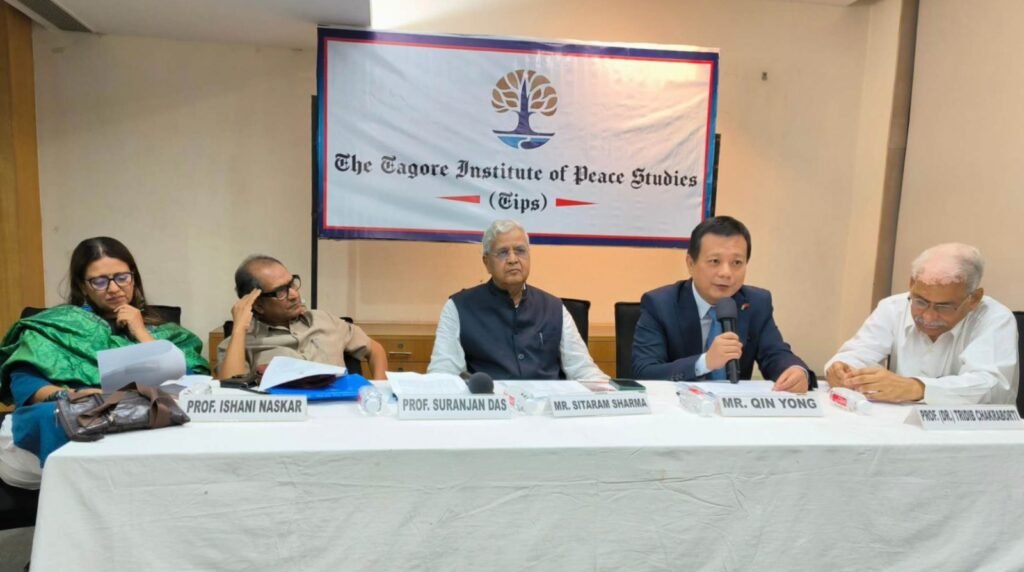
The Consulate General of China in Kolkata and the Tagore Institute of Peace Studies (TIPS) jointly organized an exclusive session on “Shifting Geopolitics: New Framework of China-India Relationship” in Kolkata, where Acting Consul General Qin Yong delivered the keynote address. The session brought together more than 60 participants from think tanks, universities, media houses and other institutions. Among the distinguished speakers were TIPS Founder President Sitaram Sharma, Adamas University Vice Chancellor Prof. Suranjan Das, Prof. Tridib Chakraborti of Adamas University and Prof. Ishani Naskar of Jadavpur University. Joining virtually from China were Prof. Zhang Jiadong of Fudan University and Prof. Huang Yunsong of Sichuan University. In his address, Qin highlighted the new consensus reached between Chinese President Xi Jinping and Indian Prime Minister Narendra Modi during their recent meeting in Tianjin. He also reviewed the key outcomes of the Shanghai Cooperation Organization (SCO) Tianjin Summit and elaborated on the significance of the Global Governance Initiative (GGI) proposed by President Xi. Qin said the leaders’ meeting and the results of the SCO Summit have opened new opportunities for China and India to strengthen cooperation, manage differences and work toward common development. He emphasized that the Consulate General is ready to enhance exchanges across academic, cultural and economic fields in eastern India to advance China-India friendship. Experts and scholars at the session echoed similar views, noting that the long-standing friendship between China and India reflects the aspirations of both peoples. They called for expanding economic and trade cooperation, boosting people-to-people exchanges and encouraging dialogue between civilizations. Speakers also noted that the Global Governance Initiative aligns with the needs of the current era, providing a framework for emerging economies like China and India to cooperate on global challenges. They stressed the importance of closer coordination between the two countries within international multilateral platforms to safeguard their common interests. The dialogue in Kolkata underscored the importance of academic and policy exchanges at a time of shifting global geopolitics. Organizers said such platforms can help foster better understanding, reduce tensions and explore new avenues of partnership between Asia’s two largest neighbors.
PM Modi Unveils ‘GST Bachat Utsav,’ Calls It Next-Gen Reform to Boost Savings and Growth
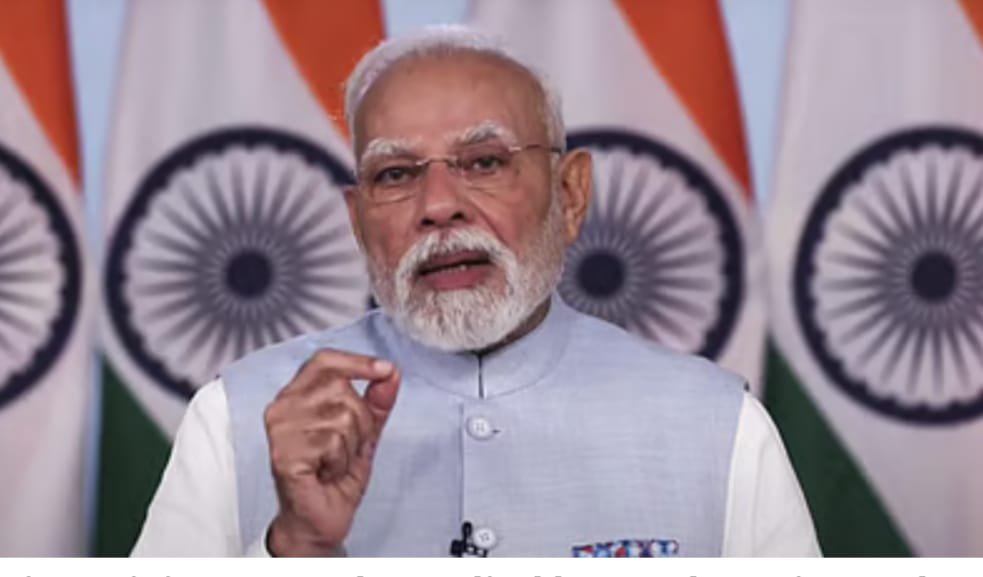
Prime Minister Narendra Modi on Sunday announced sweeping cuts in Goods and Services Tax (GST) rates, calling the move a “next-generation reform” aimed at easing the financial burden on India’s middle class, boosting youth opportunities and accelerating economic growth. In a nationally televised address at 5 p.m., Modi described the reform as a “GST Bachat Utsav,” or “GST Saving Festival,” that will take effect Monday, Sept. 22. The revised rates apply to a wide range of goods, from automobiles to daily consumer products, in what the government says is the most significant indirect tax change since GST was launched in 2017. “This reform is not only about reducing prices but about creating new opportunities,” Modi said. “The savings of our middle class will increase, our youth will benefit, and the entire economy will gain momentum.” He emphasized that cheaper essentials and consumer goods would encourage higher household spending, giving a boost to industries from agriculture to services. “When the purchasing power of people rises, it benefits every sector,” he said, linking the reform to his broader goal of a self-reliant India. Finance Minister Nirmala Sitharaman had unveiled the rate cuts earlier this month, saying they were designed to spur consumption-driven growth amid global economic uncertainty. Analysts view the tax relief as a timely measure to stimulate demand before the festive season. The announcement also came a day after U.S. President Donald Trump revealed a sharp increase in H-1B visa fees to $100,000, a move expected to hit Indian IT professionals hard. Opposition parties had pressed Modi to respond to Trump’s comments on India-Pakistan and the concerns of visa holders, but the prime minister kept his focus on domestic economic policy. The Congress party accused Modi of sidestepping pressing diplomatic issues. “The government is silent on matters affecting millions of Indians abroad,” a party spokesperson said. Still, Modi underscored that the GST reform was meant to benefit “every household” and provide lasting economic relief. “This is more than a tax cut,” he said. “It is a celebration of savings and growth for every Indian.”
Nepal Airlines to Launch First Direct Kathmandu-Guangzhou Flights Sept. 25

Nepal’s national carrier will launch its first-ever direct flights between Kathmandu and Guangzhou, China, later this week, expanding connectivity between the Himalayan nation and one of China’s largest commercial hubs. Nepal Airlines Corporation (NAC) announced Sunday that the Kathmandu-Guangzhou-Kathmandu service will begin Thursday, Sept. 25. The airline will operate three flights a week on the route — every Sunday, Tuesday and Saturday — following the inaugural flight. “All necessary preparations have been completed, and we are ready to commence the Kathmandu-Guangzhou flights,” Manoj Kumar Shah, spokesperson for NAC, said in a statement. The initial two flights are scheduled for Sept. 25 and Sept. 28 before the regular thrice-weekly service begins. The state-run carrier has set one-way fares from Kathmandu to Guangzhou at 30,000 Nepalese rupees (about $225) and round-trip tickets at 50,000 rupees (about $375). The new route places NAC in direct competition with Himalaya Airlines, a private Nepali carrier that already operates regular flights between Kathmandu and Guangzhou, and China Southern Airlines, which connects Guangzhou and Kathmandu. Aviation analysts say the addition of NAC flights will provide passengers more options and may help reduce airfare on the busy China-Nepal route, which has grown in demand due to trade, tourism and educational exchanges. With Guangzhou added to its network, Nepal Airlines now operates regular flights to 11 destinations across nine countries, including India, Malaysia, Japan, the United Arab Emirates and Saudi Arabia. The flag carrier has long sought to expand its international footprint, but competition from private airlines and operational challenges have limited its growth. The Kathmandu-Guangzhou service is being launched at a time when Nepal is working to attract more Chinese tourists and strengthen economic ties with Beijing. China is Nepal’s second-largest source of foreign visitors after India. NAC officials said they are optimistic the route will help boost tourism, especially ahead of the upcoming holiday season, and improve Nepal’s access to southern China’s thriving commercial and industrial region. “This is a milestone for Nepal Airlines and for the country’s aviation sector,” Shah said. “We believe the service will benefit travelers, traders and the tourism industry alike.”
Mamata Inaugurates Puja Pandals, Voices Concern Over Humiliation of Bengalis Outside the State

Chief Minister Mamata Banerjee on Saturday inaugurated three major Durga Puja pandals in Kolkata, but pointedly refrained from entering the marquees to view the idols. “I have come here to inaugurate the pandals, not the idols. From Mahalaya, I will begin inaugurating the idols of the Goddess,” she told reporters. The Chief Minister inaugurated the Hatibagan Sarbojanin, Tala Pratyay, and the crowd-pulling Sreebhumi Sporting Club puja, marking the start of the festive season in the city. While the organisers had hoped she would tour the elaborately decorated pandals, Ms. Banerjee kept her visit brief, limiting herself to lighting lamps and cutting ceremonial ribbons. Her remarks, however, were not confined to the rituals of Durga Puja. Ms. Banerjee used the occasion to highlight what she described as the humiliation faced by Bengalis in other parts of India. “Wherever Bengalis go, they face harassment. We must not forget that Bengalis have made enormous contributions to the country’s culture, politics, economy, and education,” she said. Ms. Banerjee urged puja committees to play Bengali songs during the festival and ensure the state’s cultural identity remained strong. “This is our biggest festival. Let it showcase Bengal’s art, music, and literature. Let the world see our tradition and creativity,” she said, underlining her call for unity around language and culture. The Chief Minister’s comments come at a time when the state government has been promoting Durga Puja as a symbol of Bengal’s cultural pride, especially after UNESCO accorded the festival recognition as an Intangible Cultural Heritage of Humanity in 2021. Officials said this year’s celebrations are expected to draw record crowds, both domestic and international. Observers noted that Ms. Banerjee’s remarks also carried a political undertone, aimed at countering both the BJP and other critics who have often accused her government of neglecting cultural identity. With elections still more than a year away, she appeared keen to reinforce her image as both custodian of Bengal’s traditions and defender of its people’s dignity. Even as the city prepared for the onrush of pandal-hoppers, police and civic authorities were working to manage crowds and traffic. State officials said more than 10,000 additional personnel would be deployed across districts from Mahalaya onwards. For Ms. Banerjee, the day’s message was clear: Durga Puja is not only about lights, pandals, and festivities, but also about asserting Bengal’s identity in the face of perceived slights.


