
Nearly 1,000 Join Congress in Murshidabad Under Adhir Ranjan Chowdhury’s Leadership
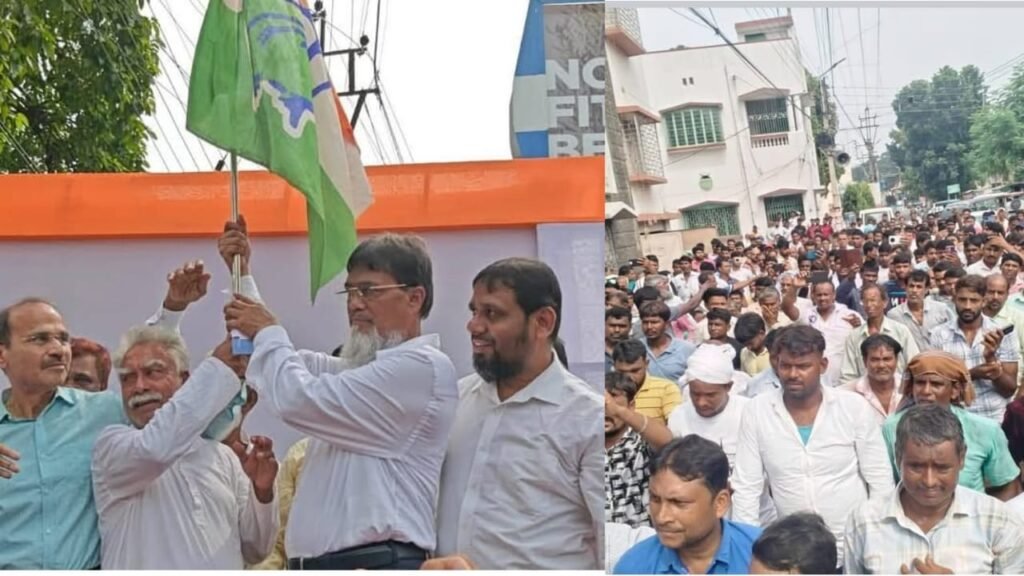
Close to 1,000 people joined the Indian National Congress in Murshidabad on Saturday, in a show of support for party veteran and Congress Working Committee member Adhir Ranjan Chowdhury. The mass joining took place in front of the district Congress office in Berhampore and drew social workers from Farakka along with leaders and workers who had crossed over from other parties. Addressing the gathering, Chowdhury said the event reflected growing disillusionment with both the Bharatiya Janata Party (BJP) and the Trinamool Congress (TMC). “It is becoming clear to people that only the Congress party under the leadership of Rahul Gandhi can defeat the BJP-RSS,” Chowdhury said. “That is why people are extending their support and joining us. We will launch ‘Voter Adhikar Sammelan’ in every block and subdivision to create a movement against vote theft by the BJP as well as the TMC.” Murshidabad District Congress president and former state minister Manoj Chakraborty welcomed the new entrants, saying the development would strengthen the organisation at the grassroots. “This mass joining gives us renewed energy and support. It will help us fight more effectively in Murshidabad and beyond,” he said. The Congress, which once dominated Murshidabad, has faced erosion of its support base in recent years due to the rise of both the TMC and the BJP in Bengal. Party leaders said the latest wave of new members marks a step in rebuilding its presence in the district ahead of the 2026 state assembly elections.
US Tech Giants Urge H-1B Workers to Stay Amid Trump Visa Fee Hike
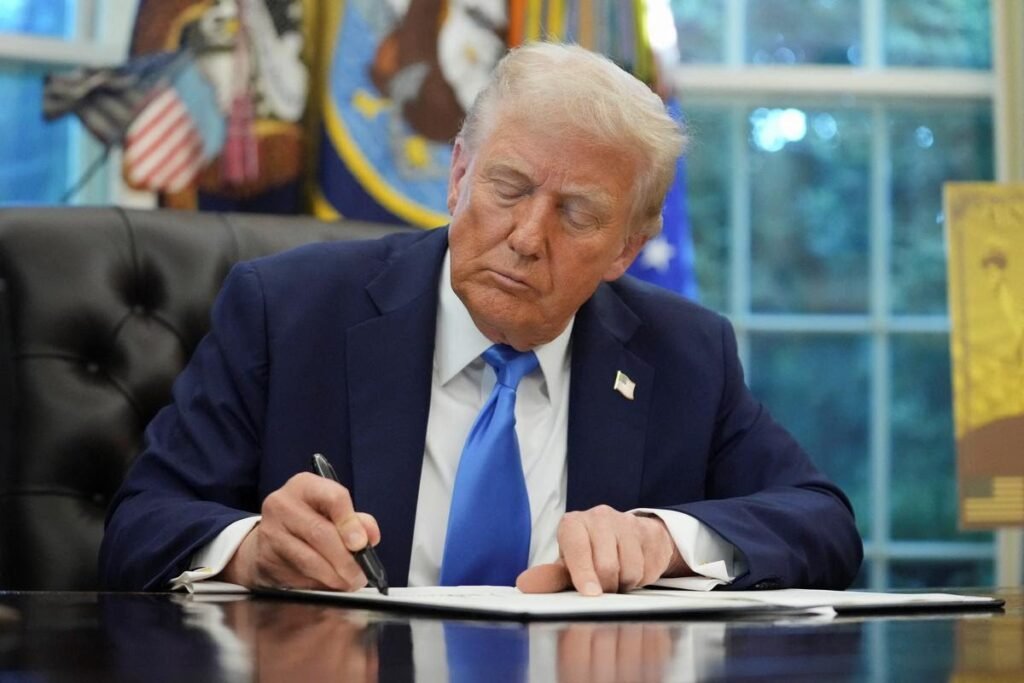
U.S. multinational companies including Meta, Amazon, Microsoft and JPMorgan Chase have urged their employees holding H-1B visas to remain in the United States, as uncertainty grows following President Donald Trump’s new directive raising the cost of such visas. Emails sent to employees this week, reviewed by Reuters, instructed H-1B and H-4 visa holders to return to the U.S. by Sunday or avoid international travel until further notice. Microsoft, in a message to its staff, said, “We are asking those on H-1B and H-4 visas to return to the United States within the specified time frame.” JPMorgan has gone further, advising workers not to leave the country at all until the company receives additional guidance. The companies have not explained the move, but industry observers believe it is tied to Trump’s latest executive order. Signed Friday, the directive imposes a $100,000 annual fee — roughly 8.8 million rupees — for companies employing workers on H-1B visas. The H-1B program, a nonimmigrant visa system, allows U.S. firms to hire skilled foreign workers, many of them from India and China. While the new policy does not ban the visa outright, labor experts say the steep fee is intended to discourage companies from sponsoring foreign talent. The technology sector, heavily reliant on international hires, could face a major disruption. According to government data, Amazon employs more H-1B workers than any other U.S. company, with more than 10,000 staff on the visa. Tata Consultancy Services follows with 5,505, while Microsoft employs 5,189, Meta 5,123, Apple 4,202 and Google 4,181. Industry leaders have yet to comment publicly on the White House’s announcement, but labor analysts warn that higher costs could slow recruitment of overseas professionals and intensify an already competitive U.S. job market for tech skills. Commerce Secretary Howard Lutnick defended the measure, saying the administration consulted “all major U.S. multinationals” before finalizing the decision. “This is about ensuring American workers are prioritized while companies contribute fairly to the system,” Lutnick said. The H-1B visa has long been a political flashpoint in Washington. Supporters argue the program supplies essential talent to keep U.S. companies globally competitive, while critics contend it undercuts American workers by lowering wages. For now, thousands of foreign professionals and their families are scrambling to comply with employers’ instructions, hoping to secure their legal status before the new rules take effect.
Durga Angan temple project begins in Kolkata’s New Town

The West Bengal government has begun work on “Durga Angan,” a large temple complex in New Town conceived by Chief Minister Mamata Banerjee, marking the Trinamool Congress leader’s latest push to highlight her government’s cultural projects ahead of next year’s Assembly elections. Banerjee had announced the project from the Trinamool’s July 21 rally, a platform traditionally used for key political messages. The state Cabinet cleared the plan in mid-August, and the Housing Infrastructure Development Corporation (Hidco) has since invited bids and started preliminary work. The temple complex is being built on 12.6 acres near Eco Park, adjacent to land owned by the Ramakrishna Mission. The plot is also close to a hotel where senior Bharatiya Janata Party leaders, including Union Home Minister Amit Shah, often stay while in Kolkata — a coincidence that has not gone unnoticed in political circles. According to the bid documents issued on Aug. 22, the estimated cost of construction is set at 2.62 billion rupees ($313 million). The deadline for bid submissions was Sept. 11, after which groundwork began. Workers have started raising the land level with earth-filling, officials said. The construction timeline has been fixed at 24 months from the date of the contract, which means the project is expected to be completed by September 2027 if no political upheaval intervenes. The move follows Banerjee’s inauguration of the Jagannath Dham temple in Digha earlier this year, a project also overseen by Hidco. Political analysts see the temples as part of a broader strategy to blunt the BJP’s Hindutva campaign by projecting Banerjee as a leader committed to inclusive religious traditions. For more than a decade, Trinamool has maintained a near-monopoly on minority votes, a bloc the BJP has accused the ruling party of appeasing at the expense of Hindus. In recent years, the saffron party has sharpened its messaging around this accusation, seeking to consolidate Hindu voters. Banerjee, however, insists her projects reflect her belief in communal harmony. Meanwhile, Hidco itself has undergone significant changes. The agency, long under the purview of the Urban Development Department, was shifted last December to the Administrative Reforms and Personnel Department, which Banerjee directly heads. Leadership has also changed hands: veteran minister Firhad Hakim was replaced as Hidco chairman late last year, with former chief secretary H.K. Dwivedi holding interim charge before finance minister Chandrima Bhattacharya took over last week. As the 2026 polls approach, the Durga Angan temple is likely to serve not only as a cultural landmark but also as a political symbol in West Bengal’s fiercely contested electoral landscape.
Selfie frenzy with PM Modi cutout marks Passenger Service Day at Kolkata airport
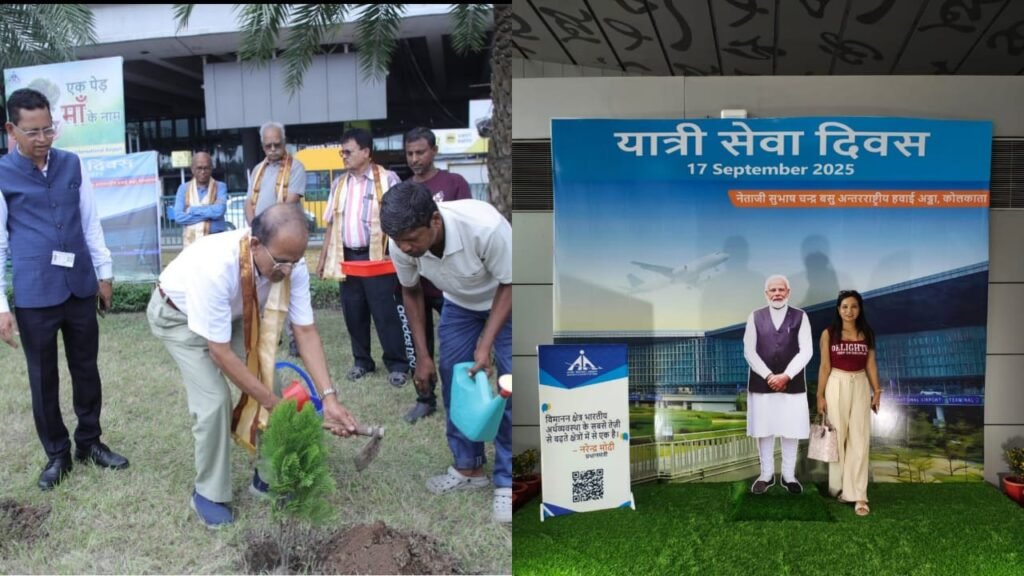
Hundreds of passengers at Netaji Subhas Chandra Bose International (NSCBI) Airport jostled for space Wednesday to snap selfies with a life-size cutout of Prime Minister Narendra Modi, an attraction coinciding with the prime minister’s 75th birthday. The rush was so overwhelming that airport authorities created three dedicated selfie zones across the terminal — at domestic arrivals, international arrivals and the security hold area. By noon, more than 500 passengers had posed with the cutouts, airport officials said. The celebration was part of Yatri Seva Diwas, or Passenger Service Day, observed across airports run by the Airports Authority of India (AAI). The annual event focuses on improving passenger experience with a range of complimentary services. “This year’s participation was remarkable,” said P. R. Beuria, director of NSCBI Airport. “Passengers availed themselves of free health check-ups, including blood pressure, blood sugar, ECG and eye tests. More than 200 people underwent free eye examinations alone.” Children traveling with families were not left out. Drawing contests and extempore speech competitions were held inside the terminal, with prizes distributed to all participants. “We are overwhelmed by the enthusiastic response,” Beuria said. In another initiative, elderly travelers and members of India’s Milly Tree Plantation group joined hands to plant saplings in the airport’s arrival garden, adding a green touch to the occasion. Senior AAI officials, including Chairman Capt. S. K. Mallick and the Executive Director (Security), reviewed the day’s proceedings alongside Beuria. Mallick said Yatri Seva Diwas offered an opportunity to reinforce AAI’s commitment to passenger-centric services. “It is a moment to showcase our efforts in delivering safe, secure and world-class services,” he told the gathering. For many passengers, however, the highlight remained the chance to take home a photo beside Modi’s smiling image. The selfie zones stayed crowded through the day, symbolizing both celebration and spectacle. Meanwhile, NSCBI Airport is preparing for another milestone on Thursday. Star Airlines will launch its maiden service between Kolkata and Purnia, with the inaugural flight scheduled to take off at 8:45 a.m. The aircraft will first land at Purnia before proceeding to Ahmedabad. Beuria will formally inaugurate the route, which officials expect will boost connectivity between eastern and western India.
Gunmen Attack Bollywood Actress Disha Patani’s Family Home; Gangster Claims Role
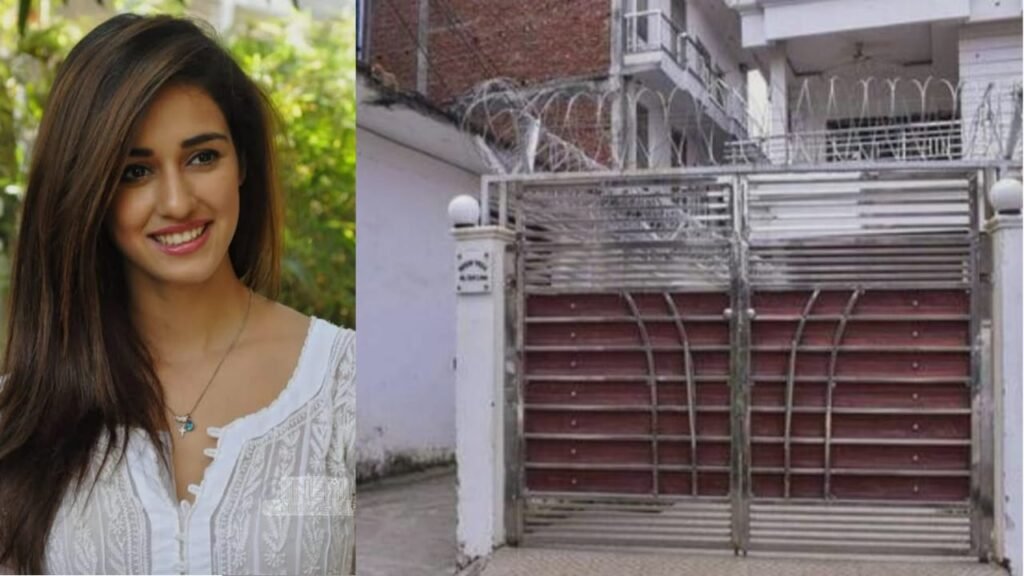
Bollywood actress Disha Patani’s family escaped unhurt after unidentified gunmen opened fire at their Civil Lines residence in Bareilly early Thursday, police said. Patani’s father, retired deputy superintendent of police Jagdish Singh Patani, her mother, and her sister were inside the house when the shots rang out around 3 a.m. No injuries were reported, but the attack triggered panic in the neighborhood. Hours later, Canada-based gangster Goldy Brar claimed responsibility in an online post, alleging the assault was linked to comments Patani and her sister had made against certain religious figures. Brar also issued fresh threats, intensifying security concerns. Taking the claim seriously, a joint team of the Uttar Pradesh Special Task Force and Delhi Police traced two suspects to Ghaziabad on Friday. Police said the men opened fire when officers attempted to arrest them, sparking a gun battle. Both suspects were injured, and one later died at a hospital. Authorities recovered a cache of weapons from the site, including foreign-made pistols and dozens of live cartridges. Investigators said preliminary findings suggest the attack was orchestrated by an international crime syndicate with direct ties to Brar’s gang. Brar, a key associate of slain gangster Lawrence Bishnoi, has been linked to several high-profile crimes in India and abroad. Officials believe his network has expanded its operations across northern India, raising concerns about gang influence on public figures. Senior police officers said additional security has been provided to Patani’s family while forensic experts examine ballistic evidence from the shooting. “We are investigating all angles, including who ordered the attack and whether more operatives are at large,” a senior STF officer said. The case has now entered a high-stakes phase, with investigators working to dismantle the network believed to be targeting prominent personalities in India.
West Bengal CM Mamata Banerjee inaugurates new 10-story ‘Anannya’ ward at SSKM Hospital
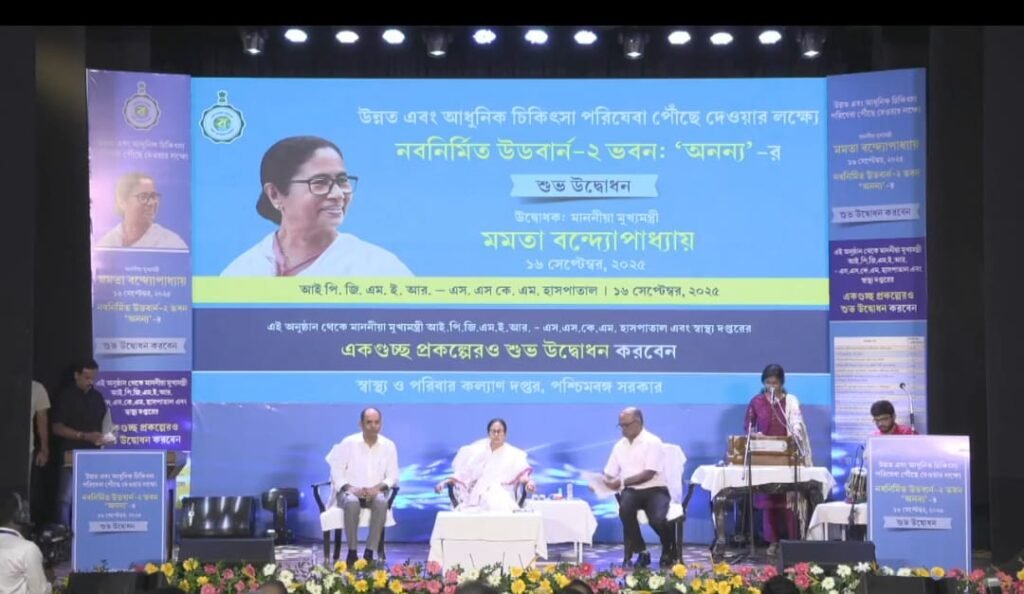
West Bengal Chief Minister and Health Minister Mamata Banerjee on Monday inaugurated a new 10-story building at SSKM Hospital in Kolkata, underscoring her government’s investments in public healthcare and marking the opening of several other health-related projects across the state. Built at a cost of 6.7 billion rupees ($80 million), the newly inaugurated “Woodburn 2” building has been renamed “Anannya” by Banerjee herself. The block houses 131 cabins and aims to provide infrastructure on par with leading private hospitals in the city. Banerjee also announced the daily rental charges for different categories of cabins and beds. Single cabins will cost 5,000 rupees, single suites 8,000 rupees, HDU-equipped beds 12,000 rupees, and ITU beds 15,000 rupees. She said hospital authorities had initially proposed rates 2,000 rupees higher, but she reduced them to make the facilities more affordable. “This infrastructure will rival even the best private hospitals,” Banerjee said at the event, which also saw the inauguration of 15 projects and the foundation stone for three others, most of them linked to healthcare. Among them was a bone bank at Sambhunath Pandit Hospital and the remote inauguration of a building constructed by the Khilafat Committee. The launch came almost exactly a year after West Bengal’s health system faced massive public protests following the rape and murder of a young doctor at R.G. Kar Hospital in Kolkata. That episode triggered unprecedented demonstrations by junior doctors and pushed Banerjee’s administration into crisis, with demands for the removal of senior officials including Health Secretary Narayan Swaroop Nigam. On Monday, Nigam was present on stage with Banerjee, a sign of how far the situation has changed in a year. Banerjee used the occasion to highlight her government’s record in healthcare spending. “In 2011, the state’s health budget was just 36.84 billion rupees. Today it stands at 213.55 billion rupees,” she said. She pointed to free pediatric heart surgeries and the Health Sathi scheme as examples of how the expansion has benefited ordinary citizens. According to her, more than 80 million people in the state have availed services under Health Sathi, with about 7,000 patients using the program daily. During the event, Banerjee was also informed that SSKM Hospital had been included in the BRICS Network. In celebration, she announced a grant of 1 million rupees for the institution. Analysts said the high-profile inauguration, along with Banerjee’s emphasis on expanded health spending, reflected both governance priorities and the political importance of healthcare after last year’s turmoil.
CISF holds special conferences to make air travel more secure

Senior security officials from across southern India gathered at Cochin International Airport this week for a two-day Central Industrial Security Force (CISF) operational conference aimed at making air travel both secure and passenger-friendly. The conference, held Sept. 11–12, was inaugurated by Praveer Ranjan, IPS, Special Director General (APS), in the presence of Jose Mohan, IPS, Inspector General of CISF. Top airport security chiefs discussed issues that directly affect travelers, including smoother security checks, improved coordination between agencies, and reducing hassles while maintaining safety. Cochin airport’s IT team showcased new technologies designed to streamline procedures without compromising security. Demonstrations included AI-enabled surveillance, full-body scanners, advanced intrusion detection systems, and cyber security upgrades. Officials said the tools are expected to cut down on long lines while keeping airports more efficient. “The focus is on making security dynamic and people-centric,” Ranjan said, stressing that while threats continue to evolve, passenger comfort and convenience must remain priorities. The Kochi conference was part of a series of regional workshops following a high-level meeting in New Delhi earlier this year. Similar events in Guwahati and now Kochi provide opportunities for security officials to share ground-level feedback and implement practical improvements. For passengers, this translates into faster screening, simplified processes, and safer journeys. The event also saw the inauguration of new welfare facilities for CISF personnel, underscoring the force’s emphasis on staff well-being. Officials said investing in workforce morale indirectly benefits travelers by ensuring alert and motivated security teams. With Cochin International Airport serving as a major gateway in southern India, authorities emphasized that adopting advanced technologies and people-friendly practices is essential. The conference highlighted the dual mission of strengthening defenses while ensuring air travel remains smooth and stress-free for millions of passengers each year.
Gang rape of college student reported near temple town Puri: police arrest two

A 19-year-old college student was allegedly gang-raped by a group of youths in a casuarina grove near a beach in Odisha’s Puri district, police said Monday. The incident, which occurred on Saturday evening about 20 kilometers from Puri town, has led to the arrest of two suspects, while one more has been detained. Police said additional individuals are believed to be involved and a search operation is underway. According to the complaint, the woman had gone to the beach with a male friend when several local youths allegedly began filming and photographing them on their mobile phones. When the couple objected, the group attacked them, police said. The friend was reportedly beaten and tied up, while the assailants dragged the woman into a nearby casuarina grove about 500 meters away, where she was gang-raped. The woman lodged a complaint at the local police station two days later, on Monday evening. Puri Superintendent of Police Prateek Singh said the survivor initially hesitated to narrate the ordeal because of trauma. “After women police officers spoke to her, she gathered courage and filed a complaint. We immediately arrested two men and detained another. We suspect more people are involved and are investigating further,” Singh told reporters. Another police official said the accused had also attempted to extort money from the couple by threatening to circulate the photographs and videos they had taken. “When the demand was resisted, the situation escalated,” the officer said. The case has drawn comparisons to a similar crime reported in May in Odisha’s Ganjam district, where a college student was allegedly abducted from Gopalpur beach and gang-raped by a group of youths. Puri’s beaches are popular tourist destinations and remain crowded throughout the year, though the latest survivor and her friend are both residents of the district, police said. The incident has raised concerns about the safety of women in coastal areas of the state, with calls for stronger policing of isolated stretches near beaches. Police said they are analyzing digital evidence and continuing raids to apprehend the remaining suspects.
Economist and Former Left Leader Prasenjit Bose Joins Congress in Kolkata

Economist and social activist Prasenjit Bose, once a prominent student leader of the Left at Jawaharlal Nehru University (JNU), formally joined the Congress party on Monday in Kolkata, saying he was committing himself to the struggle to defend India’s Constitution and voting rights. Bose, 51, received the Congress membership form from West Bengal Pradesh Congress Committee president Shubhankar Sarkar at a ceremony at Ram Mohan Mancha in North Kolkata. He was welcomed into the party by youth leader Kanhaiya Kumar, Rajya Sabha Congress member Syed Nasir Hussain, and AICC general secretary and state observer Ghulam Ahmad Mir. “The biggest challenge before the people is to resist the Special Intensive Revision so that the right to vote is protected,” Bose said. He added that he was joining Congress because he believes the party under Rahul Gandhi is leading the opposition fight on the ground. “What the Left often says in words, Rahul Gandhi is doing on the streets,” Bose said. Bose rose to prominence in the 1990s as a face of the Students’ Federation of India (SFI) in JNU. He later became a key voice for the Communist Party of India (Marxist), but resigned in 2012 over the CPI(M)’s decision to support Pranab Mukherjee’s presidential bid. In recent years, he has been active as an economist, researcher, and commentator on social issues. His decision to enter the Congress fold highlights the party’s attempt to draw on intellectuals and former Left leaders in West Bengal as it seeks to position itself as an alternative to the ruling Trinamool Congress and the Bharatiya Janata Party. “Congress can play a vital role in building an alternative to the polarization between TMC and BJP,” Bose said. Hussain, who once faced Bose as a rival in JNU student elections, called his entry into Congress “a strengthening of democratic movements.” On Facebook, Bose said his immediate objective was to reinforce democratic struggles and rebuild a progressive alternative in both the state and the nation. Several other former Left leaders, including Kanhaiya Kumar, D.P. Tripathi, and Shakeel Ahmed Khan, have previously joined Congress. However, Bose’s induction has sparked some unease within the party’s student wing, with sections accusing the leadership of giving undue prominence to outsiders over long-time workers. Despite the internal dissent, state Congress leaders said Bose’s stature as a public intellectual and economist would boost the party’s credibility in West Bengal, where it is striving to regain lost ground.
Modi opens Armed Forces commanders’ conference in Kolkata, stresses self-reliance

Prime Minister Narendra Modi on Monday inaugurated the 16th Combined Commanders’ Conference at Fort William in Kolkata, urging India’s military leadership to focus on jointness, self-reliance and innovation to strengthen operational readiness. The biennial conference, attended by the heads of the Army, Navy and Air Force along with senior officials from the defence ministry, serves as the apex forum for reviewing security challenges and shaping the country’s long-term military strategy. This year’s theme is “Year of Reforms – Transformation for the Future.” Modi was briefed on operational preparedness in the aftermath of Operation Sindoor, a recent large-scale exercise, as well as on the future of warfare shaped by emerging technologies. He also reviewed reforms carried out over the past two years and discussed the roadmap for further restructuring of the armed forces. “The prime minister complimented the Armed Forces for their role in anti-piracy operations, humanitarian assistance and disaster relief, and the safe return of Indian citizens from conflict zones,” the defence ministry said in a statement. Modi called on the defence establishment to accelerate steps to improve coordination between the services and reduce dependence on foreign equipment. The conference will continue for two days and is expected to assess structural, administrative and operational reforms, as well as India’s preparedness in the face of rising global uncertainties. Analysts said Modi’s presence at Fort William, the Eastern Command headquarters, carried symbolic weight. A sitting prime minister has rarely attended the event at the historic Kolkata garrison, with the last such visit believed to have taken place in the 1970s. The visit also came amid regional tensions. Nepal has recently witnessed violent protests while political unrest continues in Bangladesh, both of which share borders with eastern India. “The timing of the conference is geopolitically significant,” said a defence analyst, pointing to the security implications for states bordering the two neighbours. Modi’s trip marked his fourth visit to West Bengal this year, ahead of the Durga Puja festival. While he did not address any political rallies in Kolkata, opposition parties accused him of mixing official duties with electioneering. Before departing for Bihar in the afternoon, Modi met briefly at the airport with Sukanta Majumdar, former state president of the Bharatiya Janata Party.


