
West Bengal CM Mamata Banerjee inaugurates new 10-story ‘Anannya’ ward at SSKM Hospital
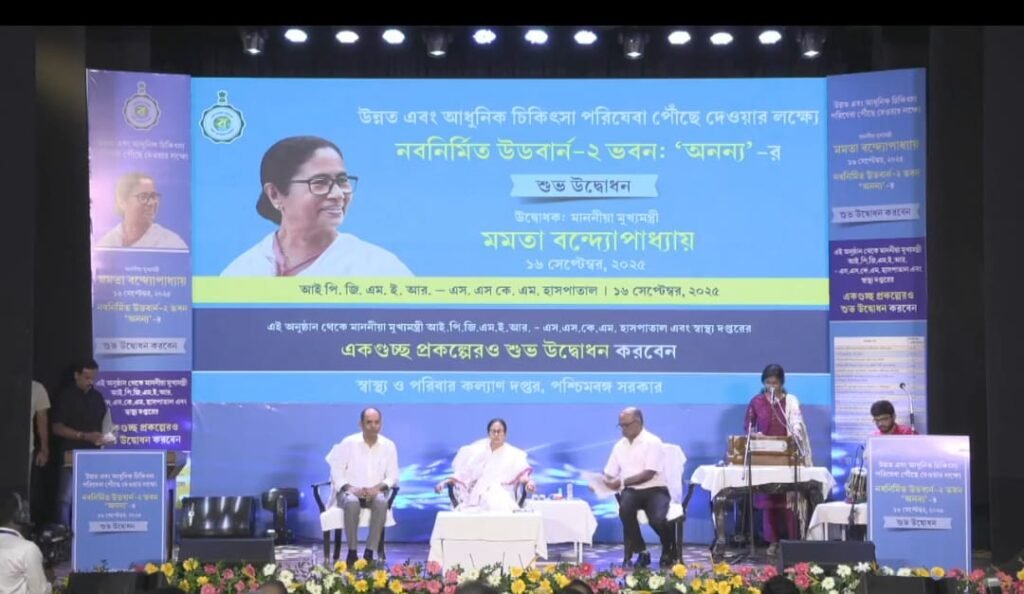
West Bengal Chief Minister and Health Minister Mamata Banerjee on Monday inaugurated a new 10-story building at SSKM Hospital in Kolkata, underscoring her government’s investments in public healthcare and marking the opening of several other health-related projects across the state. Built at a cost of 6.7 billion rupees ($80 million), the newly inaugurated “Woodburn 2” building has been renamed “Anannya” by Banerjee herself. The block houses 131 cabins and aims to provide infrastructure on par with leading private hospitals in the city. Banerjee also announced the daily rental charges for different categories of cabins and beds. Single cabins will cost 5,000 rupees, single suites 8,000 rupees, HDU-equipped beds 12,000 rupees, and ITU beds 15,000 rupees. She said hospital authorities had initially proposed rates 2,000 rupees higher, but she reduced them to make the facilities more affordable. “This infrastructure will rival even the best private hospitals,” Banerjee said at the event, which also saw the inauguration of 15 projects and the foundation stone for three others, most of them linked to healthcare. Among them was a bone bank at Sambhunath Pandit Hospital and the remote inauguration of a building constructed by the Khilafat Committee. The launch came almost exactly a year after West Bengal’s health system faced massive public protests following the rape and murder of a young doctor at R.G. Kar Hospital in Kolkata. That episode triggered unprecedented demonstrations by junior doctors and pushed Banerjee’s administration into crisis, with demands for the removal of senior officials including Health Secretary Narayan Swaroop Nigam. On Monday, Nigam was present on stage with Banerjee, a sign of how far the situation has changed in a year. Banerjee used the occasion to highlight her government’s record in healthcare spending. “In 2011, the state’s health budget was just 36.84 billion rupees. Today it stands at 213.55 billion rupees,” she said. She pointed to free pediatric heart surgeries and the Health Sathi scheme as examples of how the expansion has benefited ordinary citizens. According to her, more than 80 million people in the state have availed services under Health Sathi, with about 7,000 patients using the program daily. During the event, Banerjee was also informed that SSKM Hospital had been included in the BRICS Network. In celebration, she announced a grant of 1 million rupees for the institution. Analysts said the high-profile inauguration, along with Banerjee’s emphasis on expanded health spending, reflected both governance priorities and the political importance of healthcare after last year’s turmoil.
Nepal unrest may delay Mamata Banerjee’s return from north Bengal
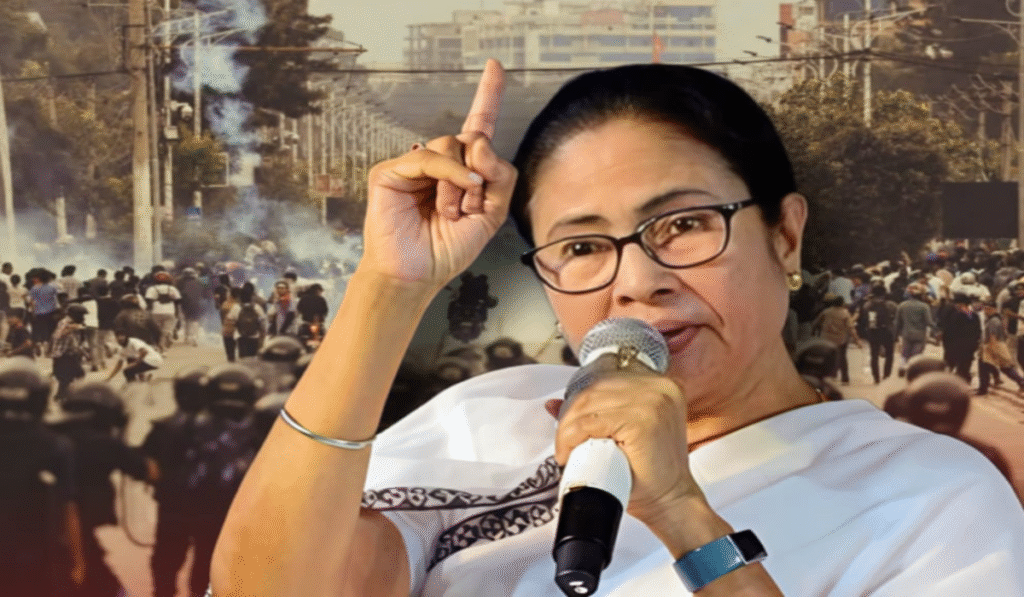
West Bengal Chief Minister Mamata Banerjee said Wednesday she may stay back in north Bengal for another day as political violence and unrest continue in neighboring Nepal. At a Press conference at Uttarkanya, the state government’s north Bengal headquarters, Banerjee said she would not return to Kolkata until the situation across the border stabilizes. “If the situation does not calm down, I will remain here,” she said. “I feel a sense of duty. I have always wanted to stand by people in times of crisis — be it a rail accident or floods in Malda. I try to be by their side.” Banerjee said she had already held meetings with district magistrates from eight districts and would decide on her return only after reviewing the situation. Taking a swipe at her opponents, she cautioned people to remain vigilant against those who “try to fish in troubled waters” for political gain. “Standing by people and exploiting a crisis are not the same,” she said. Expressing anguish over the violence in Nepal, Banerjee said she had penned a poem the previous night. “It felt terrible,” she said. “A man was set on fire alive, and people celebrated in different ways. What kind of civilization is this? Differences of opinion can exist, but burning people alive and inflicting atrocities cannot be accepted. There is no trace of humanity in this.” Reiterating her stance as an administrator, she added: “For me, people come first, before party or politics. Even if someone from my own party is at fault, I don’t spare them.” Earlier in Jalpaiguri, Banerjee announced that the state government would arrange to bring back residents of Bengal stranded in Nepal within a couple of days. She urged them not to panic. “Do not rush. Don’t invite danger upon yourselves. We are monitoring the situation closely,” she said. The chief minister spent Tuesday night at Uttarkanya, overseeing developments. “You can sleep peacefully. We are here to take care of things,” she told reporters, recalling how she had guarded the state without taking leave even during the COVID-19 pandemic. On her arrival in north Bengal, Banerjee held meetings with senior police officers. Following her instructions, surveillance along the Indo-Nepal border has been intensified. State police officials held a high-level meeting with the Sashastra Seema Bal (SSB), which guards the frontier. SSB’s 41st Battalion Commandant Yogesh Kumar Singh met with North Bengal Inspector General Rajesh Kumar Yadav and Darjeeling Superintendent of Police Praveen Prakash to discuss border security. Police stations in the border belt have since been put on alert, with naka checks underway at Panitanki and other points. Darjeeling’s police superintendent said regular communication is being maintained with Nepal Police. A district police helpline has been activated for Indians in distress.
West Bengal CM accuses BJP of using Army to dismantle protest stage in Kolkata
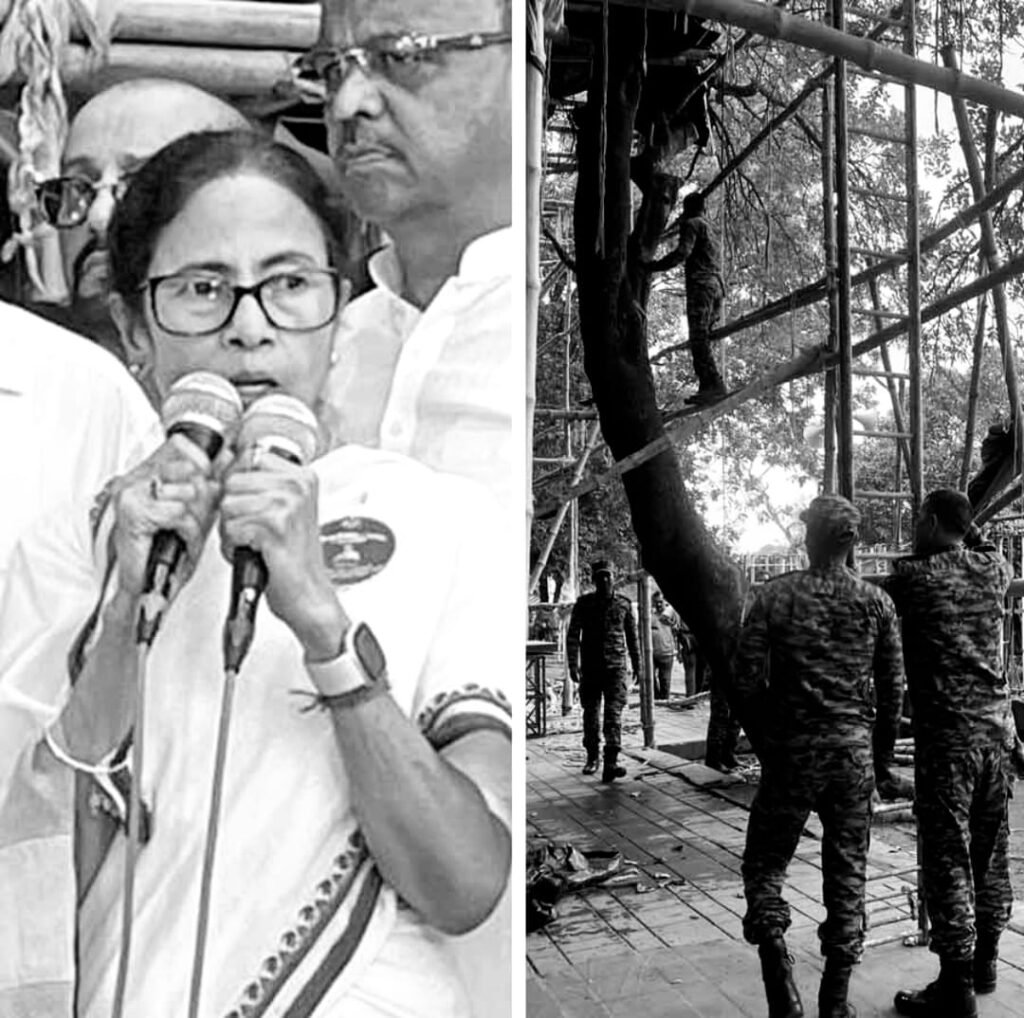
West Bengal Chief Minister Mamata Banerjee on Monday accused Prime Minister Narendra Modi’s Bharatiya Janata Party (BJP) of “politically misusing” the Indian Army after soldiers attempted to dismantle a stage erected by her Trinamool Congress (TMC) party at central Kolkata’s Dharmatala, near the Gandhi statue. The stage had been set up as part of weekly demonstrations by the ruling party to protest what it calls discrimination and harassment faced by Bengali-speaking migrant workers. Army personnel began removing the structure around midday, saying the party’s permission to keep it in place had expired, according to defence sources. Banerjee rushed to the site after being informed, accusing the BJP-led federal government of orchestrating the move. “They cut our microphone connections and broke the stage. The Army is not at fault; they are acting under Delhi’s instructions,” Banerjee told supporters. “When the Army has to follow BJP’s orders, it raises questions about where the country is heading.” Banerjee, who has often clashed with the central government over federal powers, said the protest would now be shifted to Rani Rashmoni Road, another designated venue for political rallies in Kolkata. The Army did not immediately comment beyond confirming that the temporary structure’s permission had lapsed. The BJP has not responded to Banerjee’s allegations.
RSS warns BJP against alienating Bengali migrant workers, says move could help Mamata
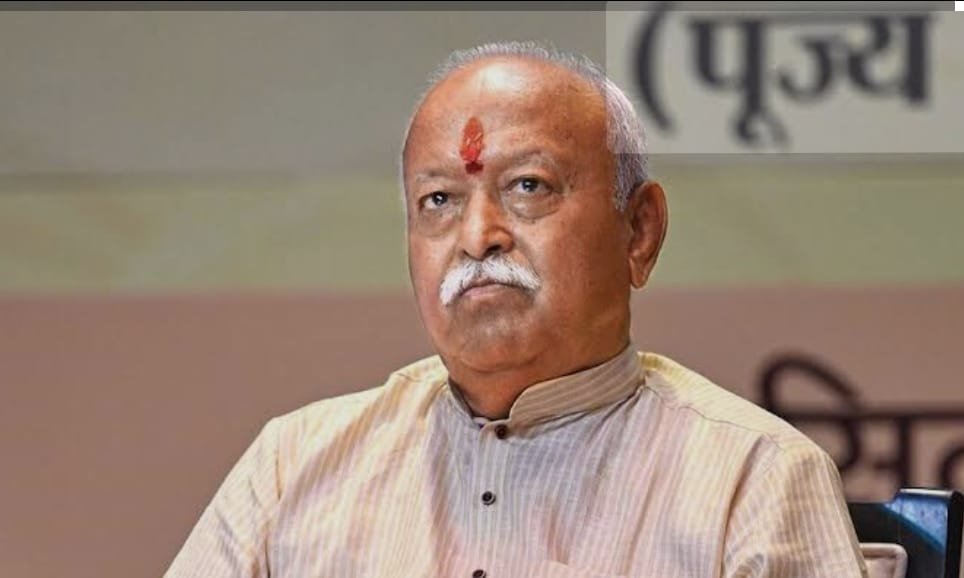
Kolkata, Aug 29 (Reuters) – The Rashtriya Swayamsevak Sangh (RSS), ideological mentor of India’s ruling Bharatiya Janata Party (BJP), has cautioned party leaders against targeting Bengali-speaking workers in BJP-ruled states, warning that such moves could strengthen West Bengal Chief Minister Mamata Banerjee. According to people familiar with the matter, senior RSS leaders have privately conveyed to BJP’s central leadership that the harassment of Bengali migrant workers amounts to a “self-goal,” handing Banerjee political ammunition. They said the issue has already given the Trinamool Congress leader an opportunity to project herself as the protector of Bengali identity. The concern is expected to feature in the RSS’s coordination meeting scheduled from Sept. 5-7 in Jodhpur, Rajasthan, where RSS chief Mohan Bhagwat will be present, the people said. The organization, which has been expanding its grassroots presence in West Bengal in recent years, fears the incidents could hamper its outreach. RSS leaders have also raised the matter with Maharashtra Chief Minister Devendra Fadnavis and a senior federal minister, underscoring that no Indian citizen should be treated as an outsider for speaking Bengali. The Sangh believes action against illegal migrants should not spill over into hostility against lawful citizens, which risks alienating West Bengal’s electorate. Banerjee’s Trinamool Congress has staged street protests over alleged assaults on Bengali workers in BJP-ruled states, accusing the ruling party of discrimination.
TMC supremo says party will expand seat tally in 2026 polls
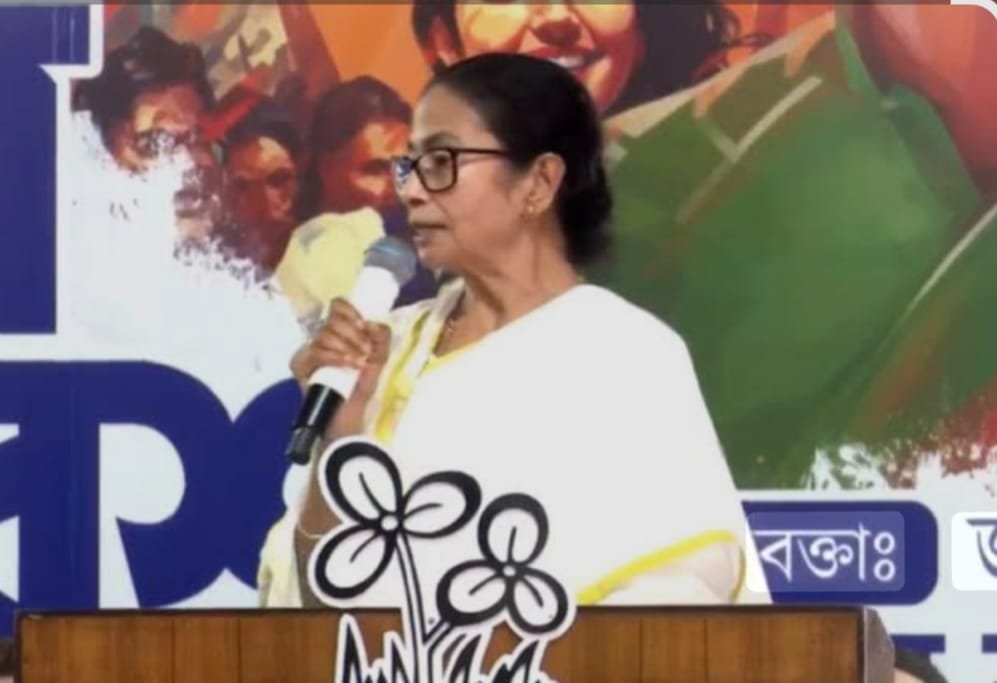
With seven months still to go before assembly elections in West Bengal, Chief Minister Mamata Banerjee has declared that her Trinamool Congress (TMC) will increase its tally of seats, a rare public prediction from the party chief. Banerjee, usually cautious about making numerical forecasts, told a student wing rally on Thursday that TMC would win more seats than it did in 2021, when it secured 215 of the 292 contested seats. “Remember, in the next election your seats will increase. The reason is we deliver development and we will continue to do so,” she said. Her nephew and party’s second-in-command, Abhishek Banerjee, made a similar assertion at the same event, claiming the Bharatiya Janata Party (BJP) would struggle to cross 50 seats. The BJP had won 77 seats in 2021 but its strength has since declined following defections and bypoll defeats, leaving TMC with 219 seats in the 294-member house. Party strategists say Banerjee’s unusual prediction is aimed at projecting confidence, energising TMC’s grassroots network, and unsettling rivals. Senior leaders argue the government’s extensive welfare schemes, particularly targeting women and minorities, coupled with TMC’s organisational control at the booth level, leave little space for the BJP to expand despite attempts at religious polarisation. Analysts, however, note that the ruling party will enter the 2026 polls carrying 15 years of anti-incumbency, a factor that could weigh on voter sentiment as it did against the Left Front in 2011 after more than three decades in power. Banerjee also used the occasion to hit out at the Election Commission, accusing it of intimidating state officials after four bureaucrats were suspended. “The Election Commission comes and goes, but the state government remains,” she said, signalling defiance amid growing friction between her administration and the poll body.
West Bengal CM Questions AIIMS Survey, Links It to NRC Exercise
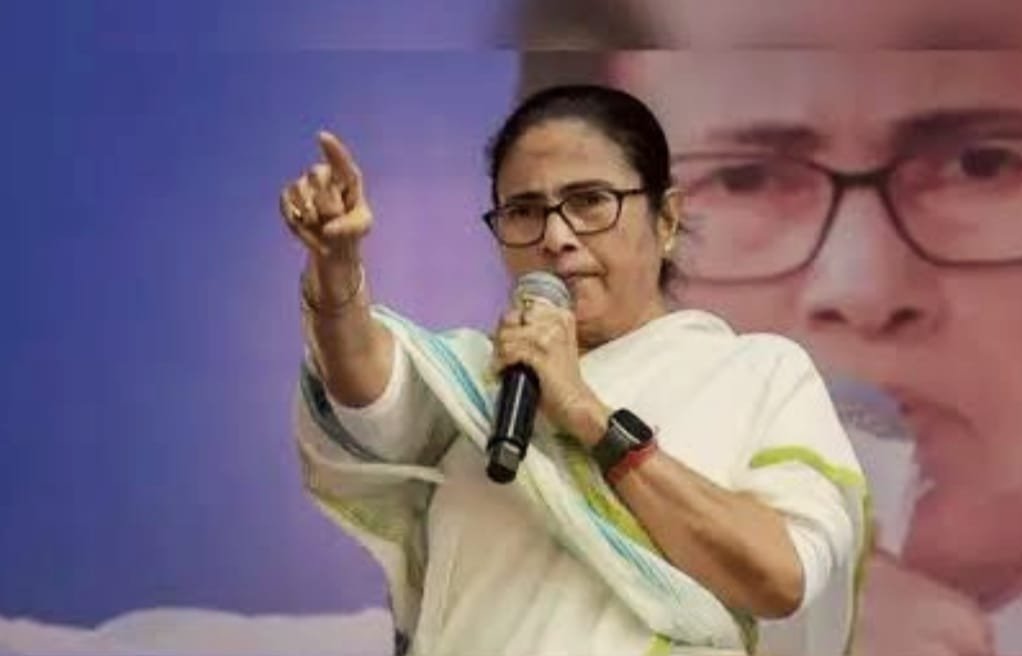
West Bengal Chief Minister Mamata Banerjee has raised strong objections to a survey being conducted by the All India Institute of Medical Sciences (AIIMS) Kalyani, alleging that the exercise—ostensibly on mental health—was in fact aimed at collecting data for a future National Register of Citizens (NRC). Speaking at a press conference in Nabanna on Monday following a state cabinet meeting, Ms Banerjee warned citizens against sharing personal information with surveyors. “I have learnt that AIIMS Kalyani, for which we had given land, is carrying out a survey in the name of mental health, but the real purpose is NRC,” she told reporters. The Chief Minister further stressed that the state government had no involvement in the survey. “If the state conducts such an exercise, people will be informed beforehand. But this direct involvement in political work is not acceptable. I urge AIIMS not to play this game,” she said, cautioning residents to “stay alert and not provide details to anyone.” According to sources, Ms Banerjee also flagged the matter during the cabinet meeting, reiterating that health was a subject under the state list and accusing a central institution of overstepping its mandate. AIIMS Kalyani has since issued a statement clarifying its position, although details of the clarification remain limited. The controversy touches a raw nerve in West Bengal, where the NRC—implemented in Assam in 2019—remains a politically charged issue.
Mamata Banerjee targets voter list overhaul, Bengali identity ahead of 2026 polls

West Bengal Chief Minister Mamata Banerjee on Thursday launched a scathing attack on the Election Commission of India and the central government over the ongoing Special Intensive Revision (SIR) of the electoral roll, warning that the exercise could be a veiled attempt to disenfranchise voters, especially from marginalised communities. Speaking at an event marking World Adivasi Day in Jhargram, Banerjee alleged that the central government was attempting to manipulate the voter list under the guise of bureaucratic formalities. She also pledged to resist what she described as a conspiracy against Bengali identity, indicating that the twin issues of voter disenfranchisement and linguistic pride would shape her campaign in the 2026 state assembly elections. “If someone tells you to fill out a form promising benefits, don’t do it without understanding. Your details could be used to remove your name from the voter list. Then they will send you an NRC notice,” Banerjee warned, referring to the controversial National Register of Citizens. The Chief Minister alleged that the new voter list norms require individuals born before or in 2002 to produce their parents’ birth certificates. “Only 60% had birth certificates back then. How can those born after 2004 be expected to provide their parents’ certificates?” she questioned, calling the demand discriminatory and impractical. Banerjee further alleged that the Election Commission had changed rules arbitrarily, saying, “Just possessing an EPIC card isn’t enough anymore. You need to cross-check your name in the new voter list.” She accused the Centre of targeting state government officials for resisting these changes. “Two of my officers were suspended and sent notices yesterday. On what basis? The elections haven’t even been announced yet. I won’t let anyone be punished unjustly,” she said. Earlier this week, the Election Commission had recommended FIRs against two Electoral Registration Officers (EROs) in West Bengal for alleged lapses in the voter list revision process. The Commission also wrote to West Bengal Chief Secretary Manoj Pant urging disciplinary action. Banerjee also turned her fire on BJP leaders for comments allegedly questioning the legitimacy of the Bengali language. “If Bengali is not a language, then in what language was the national anthem written? What language did Tagore, Swamiji, Raja Rammohan Roy, and Vidyasagar speak?” she asked, adding, “Language is identity. Language is pride.” In a pointed criticism of the BJP, Banerjee said, “These people were born with silver spoons in their mouths. They don’t understand the struggles of the working class.” Banerjee’s remarks mark a sharp escalation in political rhetoric ahead of the 2026 state elections, with the Trinamool Congress positioning itself as the defender of both voter rights and Bengali cultural identity.
BJP MP from Kanthi urges cyber cell of Delhi police to inquire over CM’s assault claim on Bengali-speaking woman

BJP MP Soumendu Adhikari has lodged a police complaint in Delhi against West Bengal Chief Minister Mamata Banerjee, alleging the dissemination of fabricated and communally provocative content through social media. Adhikari urged the Delhi Police to register an FIR against Mamata Banerjee under the Indian Penal Code (IPC) and the IT Act, preserve and examine the original social media content, investigate the alleged conspiracy involving a political worker and a journalist, and initiate appropriate penal action. In his letter addressed to the station house officer of the Cyber Crime Branch of Delhi Police, Adhikari accused Banerjee of sharing false information with the intent to defame the city police and disturb public order. According to Adhikari’s letter, on 27 July, Mamata Banerjee posted a message on her social media account alleging that a Bengali-speaking woman and her child were brutally assaulted by Delhi Police officers during a verification drive. “The post further insinuated that the act was communal in nature and sought to project the Delhi Police as oppressors of linguistic minorities,” he said. The Kanthi MP claimed that such a post, coming from a constitutional functionary, was widely circulated online, sparking public outrage and causing reputational harm to the police force. BJP MP mentioned the clarification of Abhishek Dhania, Deputy Commissioner of Police, East Delhi, Monday that the woman, Sajnur Parveen, had fabricated her story. Initially, she alleged that four men in civil clothes abducted her and her children on 26 July and extorted Rs 25,000. However, scrutiny of CCTV footage and technical evidence revealed that she left her home voluntarily with her children, and no coercion was involved. Further interrogation revealed that Parveen confessed to fabricating the story under the influence of her uncle, a political worker in West Bengal’s Malda district, and a journalist. “The intention behind the video was to create a false narrative and circulate it in social media for political and defamatory purposes,” alleged Adhikari in his letter.
ONGC Secures Land for Oil Project in Ashoknagar Without Major Disputes

India’s state-run Oil and Natural Gas Corporation (ONGC) has secured land for crude oil extraction in Ashoknagar, West Bengal, without any significant land acquisition disputes, thanks to intervention by a core committee formed by the state government. The development marks a major breakthrough in a project that had earlier stalled for years due to land availability issues. ONGC had first discovered oil reserves around a decade ago in the Baigachi area of Ashoknagar in North 24 Parganas district. A second discovery was later made in Pumlia under the Bhurkunda Panchayat. Most recently, fresh reserves were found in Kakpul, located in Ashoknagar’s Daulatpur area. To address potential land disputes, the West Bengal government devised a special compensation package. Local MLA and North 24 Parganas Zilla Parishad Chairperson Narayan Goswami said, “Under the Chief Minister’s directive, we formed a core committee comprising the district magistrate, block development officer, and panchayat officials to directly engage with landowners. That helped us secure the land.” Earlier, ONGC had halted operations in Baigachi after completing preliminary drilling due to a lack of additional land. However, West Bengal Chief Minister Mamata Banerjee had allocated 15 acres to ONGC at a token lease of just one rupee to support further exploration. Over the past five to six months, ONGC sought formal clearance from the state to begin full-fledged drilling in the area. It has since acquired land on lease from owners in the two earlier locations and has now added the Kakpul site to its exploration portfolio. Officials say similar efforts are underway at other prospective sites nearby. Goswami emphasized the state’s commitment to an industry-friendly environment, stating, “The Chief Minister has made it clear that land issues should not hinder industrial progress. In coordination with local municipalities and panchayats, we’ve ensured a smooth path for investors.” Plans are also being drawn up to provide employment opportunities to the families of land donors, especially for their children, as part of a broader compensation package. However, questions have emerged regarding delays in the project’s execution. Addressing the concerns, Goswami said, “Criticism is easy, but such large-scale projects involve complex technical processes. Once those are resolved, work will proceed as planned.”
West Bengal CM Mamata Banerjee Accuses Centre of Withholding Funds, Vows to Continue Development
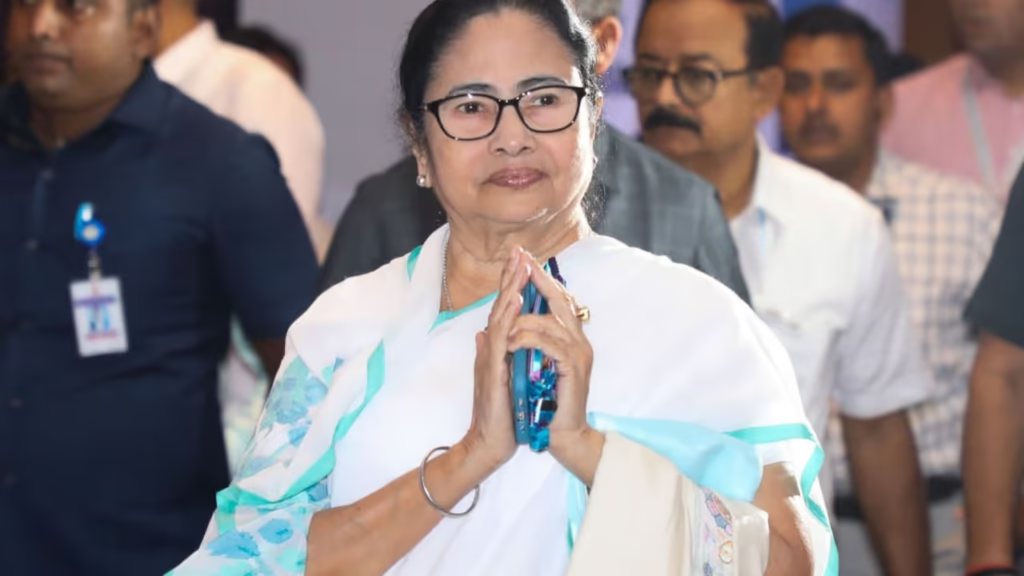
West Bengal Chief Minister Mamata Banerjee on Monday accused the central government of deliberately withholding funds owed to the state, but said development work would continue regardless of what she described as “political discrimination.” Speaking at an administrative review meeting in Bolpur, Banerjee reiterated allegations that the Centre has been persistently depriving West Bengal after failing to “gain political control” over it. She also referred to recent reports of alleged harassment of Bengali communities in several BJP-ruled states. “The Centre has stopped releasing funds. But even in this situation, we must carry forward development work,” Banerjee told senior officials and elected representatives. “The work will be funded entirely by the state.” She outlined a decentralised funding plan in which district councils (Zilla Parishads) and Panchayat Samitis will each contribute 5% of local development funds, while Members of the Legislative Assembly (MLAs) will allocate INR 1 million (approximately $12,000) each from their local area development budgets. The remaining funds will be provided by the state government, she said, adding that all contributions will be coordinated through the respective District Magistrates. Banerjee has frequently accused Prime Minister Narendra Modi’s government of financially discriminating against opposition-ruled states, particularly West Bengal, where her Trinamool Congress party has held power since 2011. The federal government has not immediately responded to her latest allegations.


