
West Bengal CM Protests BLO Training, Says State Was Not Informed
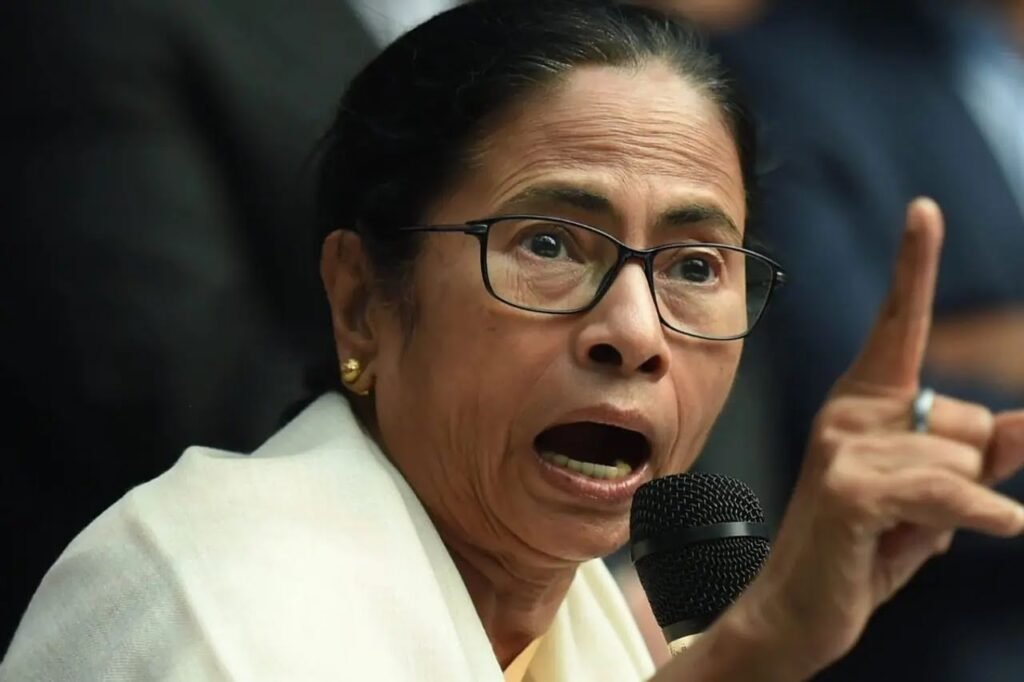
West Bengal Chief Minister Mamata Banerjee on Sunday expressed strong objections over the Election Commission’s ongoing training of Booth Level Officers (BLOs), claiming her administration had not been informed in advance. Speaking at a public event in Kolkata, Banerjee said she was unaware that the Election Commission of India (ECI) had initiated the training process under the ongoing Special Intensive Revision (SIR) of electoral rolls. She alleged that no permission was sought from the state’s chief secretary, raising questions over what she described as a unilateral move by the ECI. “The training has started without informing me or the state government. Why was the state kept in the dark?” Banerjee asked, adding that district magistrates had also failed to notify her office. She warned BLOs not to exclude any legitimate voters from the rolls and reminded them that they remain employees of the state government. “I urge BLOs to ensure that no name is wrongly deleted from the voter list. If someone is away for a few days or has gone on vacation, that doesn’t mean their name should be removed,” Banerjee said. “Many Bengali-speaking citizens are already facing harassment. We must stand by them.” The ECI has commenced training for BLOs across multiple districts including Nadia, North and South 24 Parganas, and Murshidabad as part of the SIR process, which aims to update electoral rolls and ensure that only eligible Indian citizens remain registered. Similar exercises have recently begun in Bihar, marking the first SIR there since 2003. According to officials, the current drive will expand to other regions in phases and is being seen as part of preliminary preparations ahead of nationwide electoral roll revisions. The controversy comes amid a politically sensitive time in West Bengal, where concerns over voter eligibility, alleged infiltration, and electoral transparency have heightened tensions between the state government and the central election authority.
West Bengal CM Mamata Banerjee Accuses Centre of Withholding Funds, Vows to Continue Development

West Bengal Chief Minister Mamata Banerjee on Monday accused the central government of deliberately withholding funds owed to the state, but said development work would continue regardless of what she described as “political discrimination.” Speaking at an administrative review meeting in Bolpur, Banerjee reiterated allegations that the Centre has been persistently depriving West Bengal after failing to “gain political control” over it. She also referred to recent reports of alleged harassment of Bengali communities in several BJP-ruled states. “The Centre has stopped releasing funds. But even in this situation, we must carry forward development work,” Banerjee told senior officials and elected representatives. “The work will be funded entirely by the state.” She outlined a decentralised funding plan in which district councils (Zilla Parishads) and Panchayat Samitis will each contribute 5% of local development funds, while Members of the Legislative Assembly (MLAs) will allocate INR 1 million (approximately $12,000) each from their local area development budgets. The remaining funds will be provided by the state government, she said, adding that all contributions will be coordinated through the respective District Magistrates. Banerjee has frequently accused Prime Minister Narendra Modi’s government of financially discriminating against opposition-ruled states, particularly West Bengal, where her Trinamool Congress party has held power since 2011. The federal government has not immediately responded to her latest allegations.
Bengal Launches WhatsApp Helpline for Migrant Workers Facing Abuse in Other States
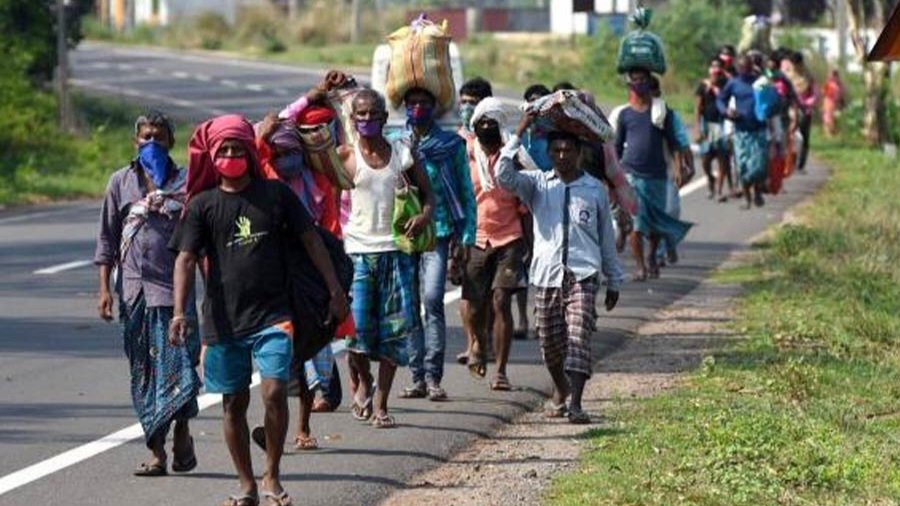
Amid growing concerns over the safety and well-being of migrant workers from West Bengal employed in other Indian states, the state police have launched a dedicated WhatsApp helpline to assist those facing hardship, abuse, or exploitation. The initiative follows a spate of disturbing reports indicating that many workers from Bengal, who travel to other states for employment, have encountered severe difficulties — ranging from wage denial and poor working conditions to physical harm and intimidation. However, victims and their families often remain unaware of where or how to seek help. In response, West Bengal authorities have issued a public appeal urging anyone facing such issues to immediately contact their local police station or the district control room. Additionally, a dedicated WhatsApp helpline has been launched for distressed families back home. The helpline number — +91 91477 27666 — will function exclusively on WhatsApp. Families can send messages to this number detailing the issue, including the victim’s name, address, and relevant circumstances. The police have assured that each complaint will be verified and followed up with the concerned state authorities to initiate necessary action. “We are receiving information from various sources about the hardships faced by our workers in other states,” said a senior state police official. “But most families don’t know how to report these problems. This helpline is meant to bridge that gap.” The move comes as Indian states grapple with growing internal migration, driven by uneven economic development. West Bengal has long been a source of labor for industries across Maharashtra, Gujarat, Delhi, and the southern states. However, oversight and support for these workers often remain minimal once they leave their home state. Activists have welcomed the initiative as a critical step toward safeguarding the rights and dignity of India’s internal migrants — a group frequently overlooked in mainstream policy discourse. “This is not just a helpline — it’s a lifeline,” said one Kolkata-based labor rights advocate. “If implemented seriously, it can prevent tragedies and reconnect vulnerable workers with vital state support.” The West Bengal Police have encouraged the public to share the helpline number widely, especially in rural areas where outbound migration is highest.
CM Mamata Banerjee to Lead Rally in Birbhum Protesting ‘Insult to Bengali Language’
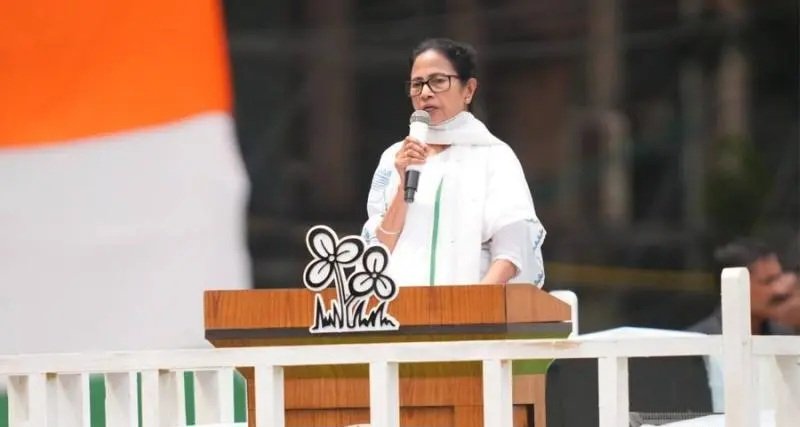
West Bengal Chief Minister Mamata Banerjee is scheduled to visit Birbhum district on July 28, where she is expected to lead a protest march condemning alleged disrespect towards the Bengali language, sources within the Trinamool Congress said on Monday. The symbolic rally is likely to take place in Bolpur, with several senior district leaders, including Kajal Sheikh, Chandranath Singh, Ashis Banerjee, Abhijit Singh, and suspended TMC leader Anubrata Mondal, expected to accompany the chief minister. The march is being organized amid growing political tensions surrounding the status of Bengali in neighbouring states and recent incidents targeting Bengali-speaking migrant workers. Banerjee, who has repeatedly raised concerns over what she calls the “systematic sidelining” of regional languages, is likely to use the platform to send a strong political message to both her party’s base and opponents at the national level. Apart from the protest event, the chief minister is also slated to chair a high-level administrative meeting with Birbhum district officials, a source in the state secretariat confirmed. Issues related to development, law and order, and public service delivery are expected to be discussed. Following the day’s engagements, Banerjee will spend the night at Ranga Bitan, the state guest house in Bolpur. She is scheduled to return to Kolkata on July 29. The Birbhum district administration has intensified security measures in anticipation of the chief minister’s visit, with a detailed deployment plan reportedly underway to ensure a smooth event and public order during the march. This visit marks Banerjee’s renewed attempt to assert regional identity politics ahead of key political milestones in the state.
Bengal Launches ‘Amar Para, Amar Samadhan’ Scheme to Deliver Grassroots Governance Ahead of 2026 Polls
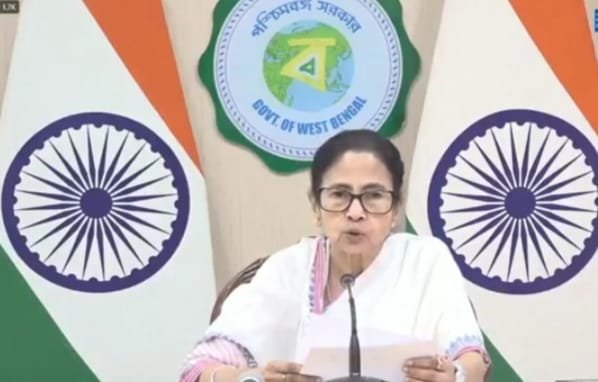
West Bengal Chief Minister Mamata Banerjee on Tuesday launched a new grassroots governance initiative titled ‘Amar Para, Amar Samadhan’ (Our Neighborhood, Our Solution), aimed at addressing hyper-local civic and administrative issues directly at the booth level. The announcement comes a day after Banerjee cited central deprivation statistics at a political rally, reinforcing her narrative of state resilience through welfare and outreach. Addressing a press conference at the state secretariat Nabanna, Banerjee said the programme is designed to make government services more accessible and responsive, particularly to rural and marginalized communities. “This is a small programme now, but it will expand. For the first time in the country, the government is reaching every booth to listen to people’s issues and solve them on the spot,” Banerjee said. The scheme will group three polling booths into one unit, with each unit hosting a single-day government camp. With approximately 80,000 booths across the state, the camps are set to begin on August 2 and will run over a period of two months, excluding a 15-day break during the Durga Puja festivities. At each camp, government officers will spend the day listening to local grievances and determining feasible solutions in real time. The process will be digitized via an online portal to ensure transparency and traceability. A budget of ₹10 lakh (approximately $12,000) has been allocated per booth, totaling over ₹8,000 crore (roughly $960 million) for the entire project. A task force led by the state chief secretary will oversee the implementation, with corresponding district-level teams ensuring local coordination. The scheme is seen as part of the Trinamool Congress’s broader outreach strategy ahead of the 2026 state assembly elections, positioning Banerjee’s administration as responsive and proactive in the face of alleged federal neglect.
Mamata Banerjee Calls for New Language Movement to Protect Bengali Identity
West Bengal Chief Minister Mamata Banerjee on Sunday issued a sharp call to defend the Bengali language and identity, warning against what she described as “linguistic terror” in several BJP-ruled states. Speaking from the Martyrs’ Day rally stage in Kolkata, Banerjee hinted at launching a renewed language movement to safeguard Bengali speakers facing discrimination outside the state. “There’s a concerted attack on the Bengali language. People are being branded as Bangladeshis just for speaking Bengali in other parts of India,” Banerjee said. “Who has the right to decide what language someone speaks or what food someone eats? Everyone’s rights will be protected in Bengal.” Banerjee, who is also the chief of the Trinamool Congress, accused the BJP of targeting linguistic and cultural diversity and urged her party members to resist these trends through organised public action. Outlining a plan of resistance, she instructed her party’s MPs to lead peaceful demonstrations alongside civil society representatives at the Bhasha Shahid Udyan (Language Martyrs’ Memorial). She also proposed weekend rallies and meetings involving speakers of all languages to show solidarity. “When language becomes a tool of politics, we must not retreat even an inch,” Banerjee said, declaring her intent to preserve linguistic rights. “In Bengal, every language will be respected, but we will not allow anyone to trample on our mother tongue.” The Chief Minister’s speech came amid growing concern over Bengali-speaking individuals allegedly facing harassment in parts of northeastern India. Echoing the tone of an agitation reminiscent of the historic language movements in the subcontinent, Banerjee concluded with a promise: “We will continue to fight for the honour of Bengali and the rights of all languages.”
Calcutta High Court Flags Traffic Disruption Ahead of Trinamool’s 21 July Rally
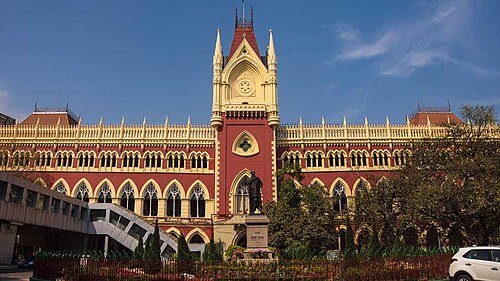
The Calcutta High Court on Thursday issued strong observations over possible disruption to public life due to the Trinamool Congress’s annual 21st July rally, prompting concerns over traffic management in the city. The remarks came during a hearing on a petition filed by a Left-affiliated lawyers’ body, which expressed apprehension that the large-scale political event could paralyse central Kolkata for hours. While Justice Tirthankar Ghosh clarified that the court would not interfere with the rally this year, he questioned the burden such events place on ordinary citizens. “How long can the public tolerate this?” he asked, signalling displeasure at the scale of inconvenience anticipated. The state’s Advocate General defended the rally, saying permissions were obtained through due process. “Even during visits by the President or Prime Minister, similar traffic restrictions are imposed. This rally has been held for over three decades,” he said. The court, however, was not convinced. “Will the Kolkata Police Commissioner give an undertaking that there will be no traffic jams?” Justice Ghosh retorted, adding that authorities must be mindful of public tolerance limits. Issuing specific instructions, the court directed that: No rally-bound participants may enter the city after 11 a.m. on Sunday; Only those already present in Kolkata by then may attend the rally; At least one-third of the road space must be kept clear for vehicular movement. The petitioner, lawyer Shamim Ahmed, argued that while he was not opposing any political event, there must be parity in how permissions are granted. “Why is one party allowed such access while others face restrictions?” he asked, citing a July 16 notification that warned of 20-hour traffic closures in parts of central Kolkata. In response, the state’s counsel said traffic regulations apply uniformly to all major events, including religious festivals and rallies by other parties. The court further suggested that future political gatherings of such magnitude be held in large venues like stadiums to reduce strain on public infrastructure. “Why not use a stadium with a capacity of one lakh? The roads belong to everyone,” Justice Ghosh said. The court also instructed the West Bengal government to develop a comprehensive policy for large-scale public events to prevent future hardship to residents. Observers note that the 21st July rally, commemorating the 1993 police firing on Youth Congress workers, has over the years become a show of strength for the ruling Trinamool Congress. But with growing urban congestion, questions over the location and scale of such events are gaining prominence. The state government is yet to respond to the High Court’s suggestions.
BJP alleges political motive behind move by TMC to hold protest over harassment of Bengalis
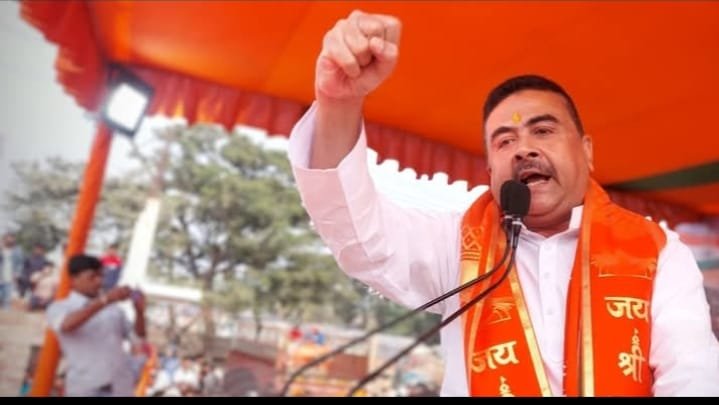
KOLKATA, 16 JULY: Leader of Opposition in Bengal assembly Suvendu Adhikari today said that in the name of Bengali sentiment, the ruling Trunmul Congress is trying to gain electoral profit. He accused Chief Minister Mamata Banerjee is taking the help from other than Bengali IAS and IPS officers to run the state administration and constantly depriving the Bengal officials to get their proper administrative positions. West Bengal’s ruling Trinamul Congress (TMC) will hold a protest rally in Kolkata on Wednesday over alleged harassment of Bengali-speaking people in several Indian states, a move the party claims is aimed at protecting Bengali identity. Chief Minister Mamata Banerjee will lead the rally, with her nephew and party’s national general secretary Abhishek Banerjee also expected to participate after a long public absence. The TMC alleges that Bengali-speaking individuals have repeatedly faced discrimination in other Indian states, where they were labelled as “Bangladeshi” and subjected to humiliation. The party said it had raised the issue with the Central government and respective state authorities but received no response, prompting the decision to launch a street protest. However, Leader of the Opposition Suvendu Adhikari of the Bharatiya Janata Party (BJP) accused the TMC of using the “Bengali identity” issue as a political ploy ahead of upcoming elections. “TMC has suddenly rediscovered Bengali pride only because elections are nearing,” Adhikari wrote in a detailed post on X, formerly Twitter. “This is nothing but a veiled attempt to shield illegal immigrants — including Rohingyas and Bangladeshis — under the guise of protecting Bengalis.” Adhikari further alleged that the state government itself has sidelined senior Bengali officials from top administrative positions. “Why were senior Bengali bureaucrats like Atri Bhattacharya and Subrata Gupta ignored for the Chief Secretary post, and Manoj Panth, a junior, appointed instead? Why was IPS officer Sanjay Mukherjee replaced by Rajeev Kumar, an outsider, as DGP?” he asked. He also questioned the government’s silence on the plight of thousands of qualified Bengali youths who lost teaching jobs due to corruption scandals, saying Mamata Banerjee’s concern for Bengali identity seems selective. “When thousands of genuine Bengali candidates are protesting on the streets after being denied teaching jobs due to scams, the Chief Minister turns a blind eye. But she rushes to defend the rights of people who may be illegal immigrants,” Adhikari wrote. The protest comes amid growing political tension in West Bengal, with the TMC and BJP engaged in a fierce battle over issues of identity, governance, and corruption. The BJP has launched a nationwide drive to identify and deport undocumented immigrants, which TMC leaders claim is targeting Bengali-speaking populations in several states. No immediate response was available from the Union Home Ministry on TMC’s allegations or Adhikari’s claims.
India Urges Bangladesh to Halt Demolition of Satyajit Ray’s Ancestral Home
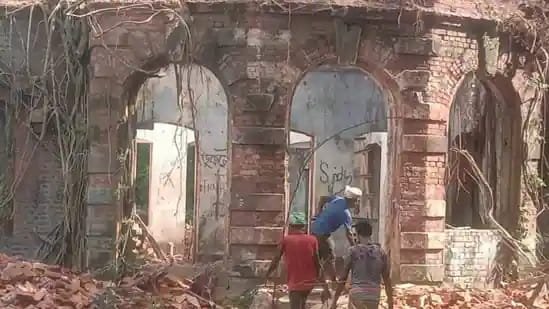
DHAKA/KOLKATA, July 16: India has urged Bangladesh’s interim government to reconsider the demolition of the ancestral home of legendary filmmaker Satyajit Ray, after reports emerged that the property in Mymensingh district is being razed by local authorities. The residence, located on Harikishore Ray Chowdhury Road, once belonged to Ray’s grandfather, renowned writer and publisher Upendrakishore Ray Chowdhury. The site had been used by the Bangladesh Shishu Academy but has reportedly been lying in disrepair for over a decade. Bangladesh’s interim government, led by Nobel laureate Muhammad Yunus following the recent ouster of Prime Minister Sheikh Hasina’s administration, has initiated demolition of the house citing safety concerns. Local child affairs officer Mohammad Mehedi Zaman told The Daily Star that the structure is at risk of collapse and will be replaced by a semi-concrete building. The development has sparked a political and cultural backlash across the border in India. West Bengal Chief Minister Mamata Banerjee raised strong objections on Tuesday, urging the Bangladesh authorities to preserve the historic site and calling on New Delhi to intervene. Following her appeal, India’s Ministry of External Affairs issued a statement highlighting the property’s historical and cultural significance. “The ancestral home of Satyajit Ray is not just an architectural structure but a symbol of shared heritage and literary excellence. We urge the Bangladesh government to preserve and restore the site instead of demolishing it,” the statement said. India has offered technical and financial assistance for the restoration and proposed converting the property into a literary museum, which officials say could further deepen the cultural ties between the two nations. The incident follows recent attacks on homes of other prominent Bengali cultural icons in Bangladesh. Just weeks ago, unidentified vandals damaged the ancestral estate of Rabindranath Tagore in Kushtia, raising concerns over the protection of heritage sites amid political instability. According to the Bangladesh Department of Archaeology, Ray’s ancestral home is over 100 years old and was taken over by the government following the 1947 Partition. Ray, who passed away in 1992, remains one of the most influential figures in global cinema. His works, including the iconic Apu Trilogy, have earned him international acclaim and India’s highest civilian honours. Cultural commentators in both countries are urging Dhaka to preserve the home as a tribute to Ray’s legacy and a testament to the shared cultural fabric of Bengal that transcends borders.
Bengal Opposition Leader Calls Parallel Rally on 21 July TMC Martyrs’ Day, Mamata Dismisses It as “Unimportant”
KOLKATA, India, July 15: Political tensions are escalating in West Bengal as opposition leader Suvendu Adhikari of the Bharatiya Janata Party (BJP) announced a counter-rally on July 21, the day the ruling Trinamool Congress (TMC) holds its annual Martyrs’ Day gathering in central Kolkata. Adhikari has also launched a state-wide campaign titled Kanya Suraksha (Girl Child Protection) in response to a recent gang rape allegation involving a law college student in Kolkata’s Kasba area, intensifying political debate over women’s safety in the state. The BJP has announced marches across various districts and a protest march to Uttarkanya, the state government’s administrative outpost in North Bengal, on the same day as the TMC rally. However, Chief Minister Mamata Banerjee has dismissed the BJP’s counter-programme, calling it insignificant. “It’s not an important issue. There’s no need to pay attention to them,” she told reporters after a cabinet meeting on Monday. Martyrs’ Day, observed annually on July 21, commemorates the killing of 13 TMC supporters during a protest in 1993. The event remains one of the party’s most significant political shows of strength. Banerjee, addressing preparations for the event, instructed ministers and officials to ensure the safe and smooth transport of party workers from across the state to Kolkata. “Our only focus is to honour the martyrs and ensure a peaceful and successful event,” Banerjee said. She directed police and administrative officials to ensure security, accommodation, and transportation logistics are carefully managed for party workers traveling to the capital. During the cabinet meeting, Banerjee also expressed concern over reports of Bengalis facing harassment in other Indian states for speaking their mother tongue. “It’s unacceptable that someone is attacked just for speaking Bengali,” she said. The Chief Minister asked her ministers to organise protests at the local level and raise awareness on linguistic and cultural respect. “Nearly 15 million people from other states live peacefully in West Bengal, and we have always welcomed them with dignity,” Banerjee said. “But over 2.2 million Bengalis working in other parts of India are facing discrimination. This cannot continue.” Officials believe the government may be preparing a larger campaign to protest these incidents, not just through administrative channels but also via cultural and social platforms aimed at protecting Bengali language and identity.


